pen on desk

You’ve probably heard it before on your favorite law show or movie court case, but do you know what “quid pro quo” actually means?

Quid pro quo (“something for something” in Latin) means an exchange of goods or services, where one transfer is contingent upon the other.

Quid pro quo can have different meanings in different areas of the law. For instance, we typically hear this phrase in relation to employment law. So, in the arena of philanthropy and nonprofits, what does quid pro quo mean?

A charitable donation is deductible to the extent the donation exceeds the value of any goods or services received in exchange. So what happens when you donate to your favorite charity and receive something tangible in return? This is the issue of “quid pro quo” in charitable gift law.

giving gift

Quid Pro Quo Example

If a donor gives a charity $100 and receives an opera ticket valued at $40, the donor has made a quid pro quo contribution. In this example, the charitable contribution part of the payment is $60. The donor is entitled to a charitable deduction for $60, but not the entire $100.

Both the donor and donee have a responsibility here. The donor, of course, can only deduct the cost of the donation less the value of the goods/services received. The charitable organization must provide their donors clear, written documentation of the value of donations.

In fact, in these quid pro quo situations, under IRS rules, the nonprofit must provide a written disclosure statement. This required written disclosure statement must both:

• Inform the donor that the amount of the contribution that is deductible for federal income tax purposes is limited to the excess of any money (and the value of any property other than money) contributed by the donor over the value of goods or services provided by the charity.

• Provide the donor with a good faith estimate of the value of the goods or services that the donor received.

Free Consultation

Thinking about making a donation or looking for guidance regarding gift acceptance at your nonprofit, no quid pro quo is required! I offer a free one-hour consultation, with absolutely no obligation. I can always be reached by email at Gordon@gordonfischerlawfirm.com, and by phone at 515-371-6077.

super hero comic book

You are a superhero. Seriously, you have the ability to change the world or, at the very least, your little corner of it. You can affect this level of change just by asking yourself one simple question: what causes would I like to benefit in my will?

Bequests to Charities in Your Will

Yes, that’s right. You can include the nonprofits you care about most in your will, leaving a legacy after you have passed on. And, it doesn’t cost anything extra! Just the assets you’re choosing to gift. You can include charities like your church, alma mater, a local cause, or an international organization in your estate plan. And, if you ask the charity you care about most, I’ll bet they’ll tell you that the result of your charitable bequest, no matter how big or small, can make a huge impact.

What About My Kids?

When folks come to me for estate planning help, a major reason they do so—perhaps even the single reason they do so—is to benefit their children. Parents often think, “I love Charity X, but of course, I love my kids even more, and I’ve got to take care of my family.” Of course, you do! And, of course, you should! But, ask yourself another question: How much is enough for my kids? If you have lots of assets, and/or your children are adults, and successful on their own, could you provide adequate support for your children and still also include a bequest to one of more charities?

superhero-costume-children

Let’s Talk

Invite the whole family to the kitchen table sometime (even if your kitchen table is a virtual one, via email) and talk about the distributions you want to make at death. Ask if including gifts to charity from your estate plan would be appropriate and acceptable to the kids. Perhaps it’s a charity the whole family supports. Perhaps this will be the beginning of a multigenerational cycle of giving.

Why not talk about it? This can be an especially productive conversation if you can explain that taxes are going to eat up a lot of one or more of the assets anyway, and this can be avoided by giving said asset(s) to charity (since charities are tax-exempt).

Life Insurance

Sometimes when parents give a major asset(s) to charity, and their kids’ inheritance takes a real hit, they’ll buy a new life insurance policy to make up the shortfall to the kids. Or, they may even buy a new life insurance policy and name the charity directly as a beneficiary. There’s also a very helpful kind of trust called an ILIT, that significantly increases the impact of life insurance. Without getting too complicated, let me give you the basics.

An ILIT is an irrevocable, non-amendable trust which is both the owner and beneficiary of one or more life insurance policies. Upon the death of the insured, the trustee invests the insurance proceeds and administers the trust for one or more beneficiaries.

What is the Role of an Estate Planner?

When it comes to estate planning, you’re thinking about so many different variables and scenarios, so what if you forget to factor in charity? Lucky for you, that’s why I’m here—to help you maximize charitable giving. That means determining how your generosity can not only help an organization make a difference but how you can maximize the financial and estate-related benefits from giving.

Studies Showed

A 2013 study* showed how lawyers, like me, can help charitable giving factor in estate planning. The scientifically-conducted research from the UK-based Behavioural Insights Team showed that when lawyers asked clients specific questions regarding charitable giving, the results were significant. Here are the results:

  • Control Group/Baseline

Lawyers who provided no reminder or inquiry to their clients about possibly benefiting a charity in their estate plan (bequests) resulted in 4.9 percent of those clients including a charity in their plans.

  • Test Group One

Lawyers who asked their clients, “Would you like to leave any money to a charity in your will?” resulted in 10.8 percent of their clients including a charity.

  • Test Group Two

Lawyers who said, “Many of our clients like to leave money to a charity in their will. Are there causes you are passionate about?” resulted in 15.4 percent of their clients including a charity. What a dramatic increase!

Here are the approximate dollar values associated with each group:

  • Control Group/Baseline

Average bequest $5,000

  • Test Group One

Average bequest $4,800

  • Test Group Two

Average bequest $10,200

Again, test group two gives a powerful example of the difference charity-minded estate planners can make.

In the study, there were a 1,000 people in each of the groups. That means that the “Test Group Two” raised over $1 million more than the control group.

volunteers taking selfie

What this means for you is that your lawyer plays an important role in reminding, guiding, and assisting you in your charitable giving so that you can use your superpower (giving through your will) to the fullest extent.

In 2017, $35.70 billion was contributed to US charities through bequests. Imagine if everyone worked with a lawyer with a strong focus on charitable giving! The impact could be incredibly transformative for the impact nonprofits can make in our communities.

Let’s Get Started

Harness your superpowers and get started with your legacy today. The best place to start is by filling out my Estate Plan Questionnaire. It’s easy, free, and there’s no obligation. It’s simply a document that gets you thinking and planning. Already have an estate plan, but want to update it to include the causes that are near and dear to your heart? Don’t hesitate to contact me.

charitable giving presentation

If you’re a professional advisor (such as a financial advisor, insurance agent, attorney, or accountant, among others) looking for more information on how to advise your clients on smart charitable giving strategies, I’d love to speak with you and your colleagues. At every chance, I’m happy to share my firm’s mission to “maximize charitable giving in Iowa” with groups of any size!

rows of brown chairs

In terms of topics, there is actually very little in the area of charitable giving that I do not feel comfortable presenting about. So, if you have a specific subject in mind, do not hesitate to propose it. The following is a sampling of topics I’ve spoken about previously. I can easily combine multiple topics to best fit the presentation to the group’s objectives.

Planned Giving 101

  1. What is “planned giving?”
  2. Gifting during lifetime versus gifting at death
    • Advantages and disadvantages of each
    • Meet clients/donors “where they’re at”
  3. What 2017 federal tax legislation changed for charitable giving
    • Two huge challenges: charitable deduction & estate tax
  4. The seven basic estate planning documents everyone needs (and how charitable giving fits in)
  5. IRA Charitable Rollover & other gifting opportunities through retirement benefit plans
  6. The numerous benefits of the Endow Iowa Tax Credit
  7. Ins and outs of donor-advised funds
  8. Highly appreciated stock and other non-cash assets

Planned Giving 201 (Advanced Gift Types)

When I give presentations on advanced gift types, I also include a short summary of Planned Giving 101 topics.

  1. Charitable gift annuity (CGA)
  2. Charitable remainder trust (CRT)
  3. Charitable remainder annuity trust (CRAT)
  4. Charitable remainder uni-trust (CRUT)
  5. Flip CRUT
  6. Charitable lead trust (CLT)
  7. Retained life estate

Working Together is Better

I can also speak to how nonprofit staff (most especially development officers) and professional advisors can best work together for mutual benefit and for the betterment of clients.

four people around a computer

Fundraising Ethics

Another topic I’ve also discussed in the past is the ethics of fundraising: how to spot warning signs of an impending ethical dilemma; the best ways to handle common ethics concerns; what actions to avoid; etc.

Exceed Client Expectations

If you present me with a list of your most top learning objectives, I would be happy to tailor a high-quality presentation to the group targeting those specific points. Really, any presentation related to charitable giving should be about what can make an impact in the lives and decisions of your clients. Let’s work together to help you and your team exceed client expectations and make an actionable impact on charitable giving in Iowa.

Contact me via email or phone (515-371-6077) to get your learning session planned and scheduled!


Arrows pointing up

An estate plan is simply a set of legal documents to prepare for your death or disability. The specific documents you’ll need depends on various factors, including the number, size, type of your assets, and your overall estate planning goals.

If forced to list the top 10 major components and the associated goals of a comprehensive estate plan, I’d list the following (in rough order of importance):

  1. A plan for orderly disposition of all your property of your choosing.
  2. Naming guardians to raise and care for minor children.
  3. Naming fiduciaries to handle minor children’s assets.
  4. A plan to help fund the charities you supported during your lifetime.
  5. A financial power of attorney so you can name an agent to manage your financial decisions, if you are ever unable to do so, with as specific (or non-specific) directions to the agent as you desire.
  6. A healthcare power of attorney so you can name an agent to manage your financial decisions, if you are ever unable to do so, with as specific (or non-specific) directions to the agent as you desire.
  7. A plan for succession or sale of a business (often a close corporation or family business).
  8. A plan to dispose of property in a tax advantaged manner.
  9. Planning for life insurance to support those economically dependent on you and/or to provide liquidity for the estate.
  10. Making known your wishes (whether simple or complex) regarding the disposition of your final remains.

Of course, any order of importance is unique to that individual. Someone with, say, minor children will find items #2 and #3 incredibly important. Someone else with adult children, or no children at all, but with a very large estate may look at #8 as quite significant. One list doesn’t fit all, just like there’s no one-size-fits-all solution for estate planning.


woman cheering at water's edge

What are your estate planning goals? Feel free to share with others in the comments below.

Estate planning is a smart step you can take today. The easiest way to get started is with my free, no-obligation estate plan questionnaire. If you have questions or want to discuss your individual situation, don’t hesitate to reach me by phone (515-371-6077) or email.

25 Days of Giving: Global Trends in Giving 2017 Report

The 2018 Global Trends In Giving report is full of important and valuable statistics for nonprofit professionals. These statistics are not just interesting, but can also impact your donor plans and marketing strategies. But, December is an incredibly busy month with all the year-end fundraising pushes and policy reviews in prep for the coming operating year. So guess what? I read it for you! (You’re welcome.)

The 28-page report, sponsored by Public Interest Registry (PIR) with research completed by Nonprofit Tech for Good, surveyed a global sample of more than 6,000 donors in a time period from April through June of 2018. (It should be noted that although global, the results only represent the views of respondents that read in languages Arabic, English, French, Portuguese, or Spanish; have access to the Internet, and use email and/or social media.) 

Here are just a few highlighted insights from the report:

  • There are some clear similarities across generations. For instance, Millennials, Generation X, and Baby Boomers all prefer to give online, compared with options like cash, bank/wire transfer, and mail. Furthermore, approximate 14-15% of each generation group gave on #GivingTuesday 2017. Additionally, approximately 56% of donors from each generation group attend fundraising events. 
  • Millennials and Generation X donors are both most inspired to give through social media and their top cause category is children and youth. In comparison, Baby Boomers are most inspired to give through email and their top category cause is health and wellness.

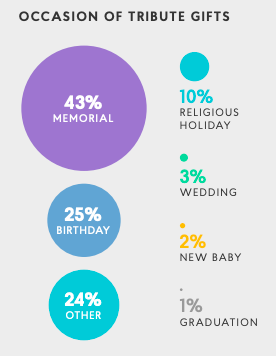
Occassion of tribute gift

  • By gender, women make tribute gifts more often than men (35% v. 21%). However, male and female donors are within 1 percentage point of one another when it comes to enrollment in a monthly giving program (~55%) and volunteering locally (~67%).
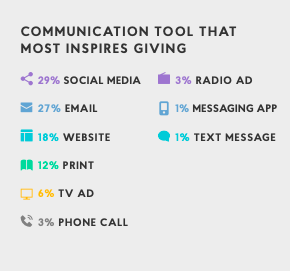
  • Social media, closely followed by email, are the communication tools that most inspire giving.

nonprofit communication

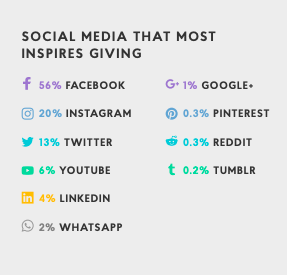
  • Planning your social media awareness and advertising for the year ahead? Facebook remains the undisputed champion of online donations.

Global giving social media

  • Your nonprofit’s website should end in .org. 68% of donors most trust the “.org” domain extension. 
  • Adopting policies such as those regarding ethics, document retention, and confidentiality are essential! 92% of donors say it is important charitable organizations “make a concerted effort to protect their contact and financial info from data breaches.”

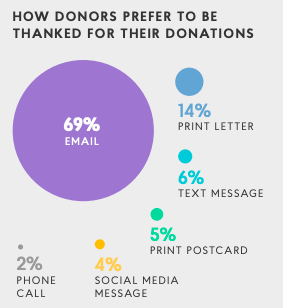
how donors prefer to be thanked for donations

  • When thanking donors, the majority (69%) prefer email the most.

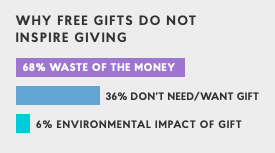
Free gifts report giving

  • When thinking about incentivizing and inspiring donors, free gifts don’t always do the trick. Only 20% of donors are more likely to donate if they’re offered a free gift. (Plus, donors need to be aware of considerations when claiming quid pro quo donations.)

Again, these are just a few of the most important figures picked from an extremely well done and detailed report, 2018 Global Trends In Giving. If you give the report a read, what were the most unexpected and unique statistics to you? I’d love to hear your thoughts and insights!

For any aspect of donation facilitation, organizational compliance, as well as legal training, I’m happy to provide beneficial services to help your nonprofit best pursue its mission. Don’t hesitate to reach out via email or phone (515-371-6077) at any time.

We’re taking a brief break from the details about the logistics of donation substantiation and the benefits of giving stocks to talk about one of my favorite subjects: books! 

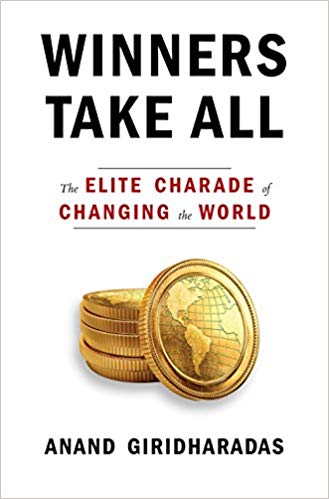
The people of Iceland have a lovely tradition called jólabókaflóð where books are exchanged with loved ones on Christmas Eve and then a cozy night is spent reading together. If you choose to start your own “Yule book flood” holiday custom, consider passing along one of the GoFisch Book Club selections we’ve chosen over the year. Which brings us to this month’s title: Winners Take All: The Elite Charade of Changing the World.Winners Take All

The author, Anand Giridharadas, explores how rich and powerful donors utilize donations not just in attempt to change the world, but to shape policy. He presents an argument that the wealthiest of donors perpetually intend to do good, but never intend less harm. The author explores tough questions, which at times, are hard to reconcile with the current state of major giving in the world today. Giridharadas also offers ideas, with a call to action for everyday citizens, on how robust social change can, and should, be more egalitarian.

Not all of the ideas in Winners Take All will be popular with all (especially not the upper crust of the richest donors), but that’s what makes this book so intriguing. It’s not afraid to push the envelope on the conversation around how the public sector operates and delve into the realities of philanthrocapitalism.

What are your thoughts on Winners Take All? I’d love to hear how this inspires your charitable giving or influences your giving strategy. Want to discuss how you can make the most impact with your year-end donation? Don’t hesitate to drop me a line!

Couple overlooking ocean on boat

Iowans’ retirement benefit plans hold tremendous wealth. Your IRAs, 401(k)s, 403(b)s, and so on, could have a huge impact on the charities you care about most.

Nonprofits should be aware that retirement benefit plans are incredibly underutilized for charitable giving. It’s in nonprofit stakeholders’ best interest to educate themselves and potential donors about the benefits of charitable giving of retirement benefit plans.

Categories of Charitable Giving

There are several ways to categorize charitable giving. For example:

  • Cash versus non-cash gifts
  • Planned giving versus “unplanned” giving
  • Income producing charitable gifts (such as charitable gift annuities and charitable remainder trusts) versus non income producing gifts
  • Gifts of different types or classes of assets

When discussing gifts of retirement assets, perhaps the most helpful categorization is lifetime gifts versus gifts at death. Lawyers sometimes call charitable gifts made during lifetime as inter vivos gifts and gifts at death as testamentary gifts.

Let’s start with testamentary gifts of retirement plan assets. This can be an easy and convenient way for your clients to support their favorite causes.

Couple dancing

Testamentary Gifts of Retirement Plan Assets

Name charity as beneficiary

You can make a very meaningful gift simply by naming your favorite charity or charities as beneficiary of an IRA, 401(k), 403(b), or other retirement plan. Giving retirement assets in this way is quite easy.  Just contact the institution holding your retirement plan, request a change of beneficiary form, fill the form out completely and correctly, and return the form. Typically naming a beneficiary in this way does not require drafting or amending a will or trust.

Keep in mind, however, that if the account holder is married, the spouse should be informed. Depending on the type and terms of the plan, the spouse may have to consent to the gift.

Tax rules may make testamentary gifts of retirement plan assets more favorable

Retirement plan assets are a good choice for testamentary gifts for tax reasons, too. In fact, the interplay of a few tax rules may make charitable gifts of retirement plan assets more attractive to you than charitable gifts of other kind of assets.

To understand why this might be so, we need to look at three important concepts:

  1. Inheritance generally is not income.
  2. Income in respect of a decedent (IRD)
  3. Step-up in basis (also called, stepped up basis)
Inheritance is not income

Generally speaking, inheritance is not income, for federal tax purposes. Most inherited property passes tax-free.

(It’s true there is an Iowa inheritance tax. To keep this simple, I’ll focus on federal tax.)

Income in respect of a decedent (IRD)

Most inherited property passes tax-free, but not all. IRD is income that the deceased was entitled to, but had not yet received, at the time of death. IRD can come from various sources, including:

  1. Unpaid salary, fees, commissions, and/or bonuses;
  2. Deferred compensation benefits;
  3. Accrued but unpaid interest, dividends, and rent; and
  4. Distributions from retirement benefit plans

That’s right—retirement benefit plans are IRD.

Federal tax law provides for IRD to be taxed when it’s distributed to the deceased’s beneficiaries. IRD retains the character it would have had in the deceased’s hands.

Step-up in basis

Step-up in basis refers to the readjustment of the value of an appreciated asset for tax purposes upon inheritance. With a step-up in basis, the value of the asset is determined to be the higher market value of the asset at the time of inheritance, not the value at which the original party purchased the asset.

Interplay Between Tax-Free Inheritance, IRD, and Step-Up in Basis

There can be interesting interplay between tax-free inheritance, IRD, and step-up in basis, which may make testamentary gifts of retirement benefit plans very attractive. Here’s a simple example:

Alex dies, with three surviving children, Brett, Casey, and Dana. At her death, Alex owned three major assets: a house, stock, and an IRA. She bequests each child one asset. What result?

Assume:

  • Alex’s house is worth $100,000. She purchased it for only $20,000.
  • Alex owns shares of stock in Acme Company, worth $170,000. She purchased the stock for just $50,000.
  • Alex’s IRA is worth $200,000.

Alex’s house is inherited by Brett. There’s no federal tax on this transfer. Brett sells the house shortly thereafter. Still no federal tax. Although Alex purchased the house for only $20,000, Brett receives a step up in basis. Brett’s basis is $100,000, the value of the house. Since she sells it for $100,000, there’s nothing to tax.

When Casey inherits the stock, no tax—as there’s no taxable event. Later, Casey sells the stock. Although Alex purchased the stock for only $50,000, Casey receives a step up in basis. Casey’s basis is $170,000, the value of the stock. Since Casey sells the stock for $170,000, there’s nothing to tax.

How about Dana and the IRA? The IRA was registered with Dana as beneficiary, but no money is taken out of it immediately, so no taxes. When Dana withdraws money from the IRA, however, Dana must pay federal income tax of up to 39.6 percent. (It is true that Dana could defer withdrawals from the IRA for a long time, and of course such deferral reduces the impact of taxes.)

To sum up, in this hypothetical, the house and stock passed to the beneficiaries without any taxable event. The IRA passed to the beneficiary, but the beneficiary will have to pay taxes when she withdraws funds.

As can be seen, testamentary gifts of retirement benefits to a worthy charity can be tax-savvy. Let’s move on to inter vivos gifts of retirement benefits to charity.

Inter Vivos Gifts of Retirement to Charity

A helpful way to discuss charitable gifts of retirement plan assets during lifetime is to break them down into three categories:

  1. IRA Charitable Rollover;
  2. Required Minimum Distributions (RMDs), and
  3. NonRMDs

 IRA Charitable Rollover

The federal law known as the IRA Charitable Rollover allows individuals aged 70½ and older to donate up to $100,000 from their IRAs directly to charities without having to count the distributions as taxable income. This gift transfer is called a “qualified charitable distribution” or “QCD.”

couple in red car

To be a valid QCD, there are two threshold requirements. First, you must be age 70½ or older. Second, the retirement plan account must be an IRA.

Age requirement of 70½

Taxpayers who are 70½ and older are required to make annual distributions from IRAs which are then included in the taxpayers’ adjusted gross income (AGI) and subject to taxes. The IRA Charitable Rollover permits those taxpayers to make donations directly to charitable organizations from their IRAs without counting them as part of their AGI and, consequently, without paying taxes on them. You can be either an IRA participant donating from your own IRA, or a beneficiary donating from an inherited IRA.

Again, the IRA Charitable Rollover requires you (whether owner or beneficiary) to be age 70½ or older. This is based on the year you reach age 70½, not the day you reach that age.

IRA Charitable Rollover is for IRAs only

QCD can only be made from traditional IRAs or Roth IRAs. Charitable donations from 403(b) plans, 401(k) plans, pension plans, and other retirement plans are not eligible for the IRA Charitable Rollover law.

Annual cap of $100,000

Your total combined IRA Charitable Rollover contributions cannot exceed $100,000 in any one year. The limit is per IRA owner, not per IRA. Also, this amount is not portable between spouses.

Eligible charities

Under the IRA Charitable Rollover, charitable contributions from an IRA must go directly to a public charity that is not a supporting organization. Contributions to client-advised funds and private foundations, except in narrow circumstances, do not qualify for tax-free IRA rollover contributions.

I must emphasize that QCD must go directly to charity. You can’t withdraw the money, and then give it to charity – rather, the IRA administrator must send QCD straight to the charity.

IRA Charitable Rollover & quid pro quo

What about gifts to your client from a charity, in return for QCD? You cannot receive any goods or services in return for QCD to qualify for tax-free treatment.

IRA Charitable Rollover and IRS substantiation

The IRA Charitable Rollover requires substantiation for the IRS. You must obtain written receipt of each IRA rollover contribution from each recipient charity.

Specific tax advantages of QCD

Keep in mind the specific tax advantages of QCD under the IRA Charitable Rollover. For Iowans who don’t itemize deductions, and so thereby don’t get to deduct their charitable contribution, the IRA Charitable Rollover obviously helps. This is even more applicable after the passing of the new tax law.

For Iowans who are “itemizers,” it may also be tax-advantaged, particularly for those who practice strategies like “bunching” donations.

IRA Charitable Rollover and QCD can’t fund split interest gifts

QCD must be a contribution that would be 100 percent deductible if paid from the owner’s non-IRA assets, so a split-interest gift will not qualify. Therefore, IRA Charitable Rollover funds generally cannot be made to a charitable remainder trust, charitable gift annuity, or pooled income fund.

No federal income tax charitable deduction with IRA Charitable Rollover

QCD, from the IRA Charitable Rollover, are excluded from your gross income for all purposes. Of course, there is no charitable deduction for any IRA Charitable Rollover funds.

IRA Charitable Rollover helps with three notable challenges to lifetime giving

Speaking very generally, there are three notable challenges to lifetime giving:

First, consider taxpayers who don’t itemize. Most fundamentally, a taxpayer has to itemize to take advantage of the charitable deduction. A taxpayer who uses the “standard deduction,” rather than itemized deductions, of course wouldn’t see any tax benefit from the charitable deduction.

Second, look at AGI percentage limits on charitable deductions. The federal income tax charitable deduction is limited to a certain percentage of adjusted gross income. The percentage is either 30% or 50%, depending on the type of property given and the type of donee charity.

Third, remember the Pease limitation. The “Limitation on Itemized Deductions” (known as the “Pease limitation,” after Donald Pease, the Ohio congressman who helped create the law), reduces most itemized deductions by 3 percent of the amount by which AGI exceeds a specified threshold, up to a maximum reduction of 80 percent of itemized deductions. The income thresholds for Pease vary by filing status.

You can readily see these three potential obstacles are just not at issue at all with the IRA Charitable Rollover. Again, simply put, QCD does not increase AGI.

IRA Charitable Rollover can fulfill RMDs

QCD, from the IRA Charitable Rollover, can fulfill RMDs. So, it’s an excellent way for Iowans over 70½ to both fulfill RMDs and help favorite causes.

Don’t confuse RMDs and QCDs

QCD and RMDs are actually completely different. It’s true that QCD counts toward RMDs, to the extent RMDs have not already been taken. But QCD can be taken, regardless of whether RMD for the year is more or less than $100,000; regardless of whether the plan participant has already taken RMD; and regardless of any other distributions from the IRA.

Charitable Giving and RMDS

two chairs on beach

The IRA Charitable Rollover applies only to IRAs. Generally, a retirement plan participant, aged 70½ or older, must take annual RMDs – whether the plan is an IRA, or a 401(k), another type of plan.

These RMDs would seem to be an ideal charitable gift. After all, if a plan participant must take an RMD anyway, why not use it to support her favorite causes?

A beneficiary who inherits a retirement benefit plan is also generally required to take annual RMDs. The same analysis would presumably apply.

Charitable Giving and Non-RMDs

Depending on individual circumstances, taxpayers may also choose to make lifetime charitable gifts using funds withdrawn from retirement benefit plans. Individuals over age 59½ may generally withdraw funds from retirement plans without penalty, make a gift with these funds, and then claim an offsetting charitable deduction. In most cases, charitable gifts made in this manner will be a “wash” for tax purposes.

Let’s Talk About Retirement

Whether you are a donor or a donee charity, I would be happy to visit with you about increasing your charitable giving. Please feel free to contact me any time for a free one-hour consultation. I am always available at gordon@gordonfischerlawfirm.com or 515-371-6077.

Holding lights

Since 1968, every Section 501(c)(3) organization is classified by the IRS as either a private foundation or a public charity. This classification is crucial for at least two reasons to anyone considering forming a nonprofit or anyone considering making a significant donation to a nonprofit.

First, private foundations are subject to much stricter regulations than public charities. Second, public charities receive more favorable tax treatment than private foundations. Let’s explore each classification a little deeper.

Public Charities

heart ceramics bowls

Public charities must attract broad donor support. Some organizations—churches, schools, and hospitals for instance—are by their very nature considered “publicly supported.” Other organizations must pass mathematical public support tests to qualify as a public charity. These tests require charities to obtain funding from numerous sources, rather than one singular source, or a small group of related funders.

When a charity passes one of the public support tests, it is demonstrating to the IRS that the general public (non-insiders) evaluated the charity’s performance and found it worthy of financial support. As a result, such charities are treated as having a sort of stamp of approval of the general public, lessening the need for the stricter IRS scrutiny applied to private foundations.

Private Foundations

Do something great in neon

Private foundations are funded by an individual, a family, a company, or a small group. Two prominent examples would include the Ford Foundation and Bill & Melinda Gates Foundation.

Private foundations are subject to a more strict regulatory scheme than public charities. There are penalties for self-dealing transactions, failure to distribute sufficient income for charitable purposes, holding concentrated interests in business enterprises, and making risky investments. The IRS recognizes two types of private foundations: private non-operating foundations and private operating foundations. The main difference between the two? How each distributes its income:

  • Private nonoperating foundations grant money to other charitable organizations.
  • Private operating foundations distribute funds to their own programs that exist for charitable purposes.

In general, private foundations can accept donations, but many do not and instead have endowments, as well as invest their principle funding. The income from the investments is then distributed for charitable activities/operations.

Deduction limits

Contributions made to public charities and private foundations may be deducted from the donor’s federal income tax. The amount of the deduction is subject to certain limits under federal tax law.

Money and receipts

Gifts to public charities receive more favorable tax treatment than gifts to private foundations—this includes donor limits. For example, a charitable cash donation to a public charity would be deductible at up to 50 percent of the taxpayer’s adjusted gross income (AGI), but the same gift to a private foundation is deductible at a rate of only 30 percent of AGI.

A word on the word “foundation”

Don’t assume that an organization with “foundation” in its title/name is indeed a private foundation and not a public charity. Of course, it could be, but many types of nonprofit organizations have adopted “foundation” as part of their name to help project a mission and/or identity. (Examples include Friends of Animal Center Foundation and the Iowa City Public Library Friends Foundation.) If you’re entirely unsure if a nonprofit you’re considering donating to is a private foundation or public charity, simply ask one of the nonprofit’s executives or appropriate contact.

If you’re wanting to make a complex gift or include nonprofits as beneficiaries in your estate plan it’s wise to work with an attorney experienced in those areas. Of course, I would be happy to help.


Have any questions? Want to discuss your charitable donation or formation of your dream nonprofit? Contact me by email or phone (515-371-6077) .

Man sitting at conference table with phone

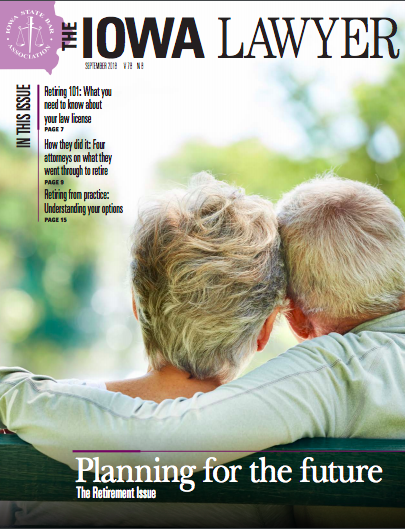
The September edition of “The Iowa Lawyer” is now out! Published by the Iowa State Bar Association, this month focused entirely on retirement-related topics. According to the ISBA, there are approximately 2,300 ISBA members who are 60 and older. And, in Iowa in general, people age 65 or older comprise 16.7% of the population. Retiring is a whole different stage in life that can come with newfound challenges as well as benefits. While geared toward Iowa attorneys, many of the insights are applicable in other industries. For instance, succession planning is important for all business owners! Similarly, retirement is a time when charitable giving often gets a boost.

Iowa Lawyer September 2018

GFLF’s piece focuses on how you can use retirement benefit plans to benefit the charities and causes you care about in a strategic, tax-wise way. This is super important for all Iowans to know (not just attorneys!). In the article we focus in on three important tax concepts:

  1. Inheritance as income
  2. Income in respect of a decedent
  3. Step-up in basis (also called, stepped up basis)

You  can read the full article by clicking here and scrolling to page 23.

Retire with a Reason

Any questions after reading? Feel to explore more on the topic in our other blog posts on the subject or contact GFLF at any time to discuss by email, at gordon@gordonfischerlawfirm.com, or by phone at 515-371-6077.
Laptop computer with blue desktop

I love getting to collaborate with wonderful professional advisors (like financial advisors and insurance agents, among many others) to promote and maximize charitable giving in Iowa. Together we get to help their clients best incorporate strategic charitable giving in to their financial and estate planning goals and plans.

People come to philanthropy from many different places and for many different reasons. Beyond the obvious tax benefits of donating to a charitable organization, there’s always that admirable intention of wanting to make a difference, of aspiring to help the organizations and causes they care about progress.

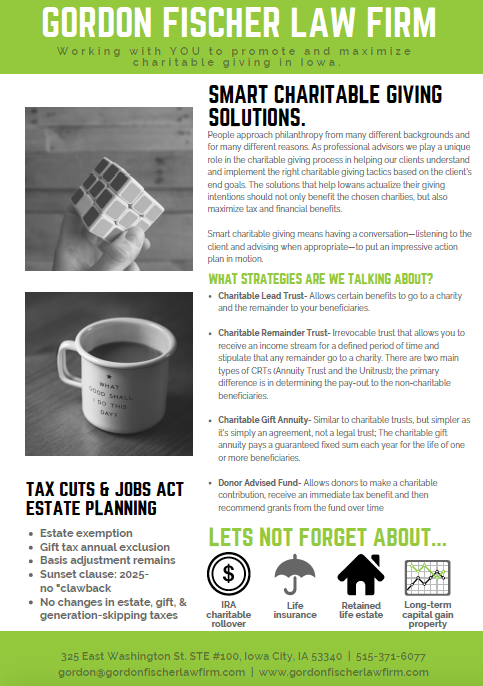
As a starting point for discussing smart charitable giving solutions, I’ve created this handy one-pager. It gives an overview of strategies like the popular donor advised fund and different types of charitable trusts, and reminds of other options like an IRA charitable rollover and retained life estate. The pdf also hits on aspects of the Tax Cuts and Jobs Act that prospective donors and professional advisors should be aware of.

Smart charitable giving guide

Click here to view the free guide to smart charitable giving solutions and then let’s continue the conversation. Additionally, you can learn more about how Gordon Fischer Law Firm works with the professional advisors here. Together I’m certain we can craft the best, legal giving solutions that align with your clients’ giving goals.