As a candidate for a job, we all remember those pre-interview jitters. You’re worried you’re going to say something awkward, fail to demonstrate your aptitude and experience, or show up at the wrong time in the wrong place. Maybe your resume has grammatical errors, or you’ll have food stuck in your teeth. And, then there’s that anxious thought that you may completely freeze up when asked a question!
But, the interview is not just a daunting affair for the prospective candidate. On the other side of the interview table, the process can also be worrisome to the interviewer! Employers want to make sure they’re hiring the most qualified candidate for the job, while also assessing if the prospective employee is aligned with the organization’s mission and will fit well with company culture. To achieve this, employers (for non and for-profits alike) must be well informed on how to conduct an effective interview. An effective interview requires at least two major components from the employer: carefully prepared interview questions and carefully phrased interview questions.
Choose interview questions with care
Carefully prepared interview questions require the employer to determine the critical success factors of the job. Prior to the interview, employers should formulate a detailed job description along with a list of the qualities, skills, certifications/degrees, and previous work experience they are looking for in a candidate. From this, an employer should be able to formulate questions in advance, some open-ended and some not, to ask the candidates.
Avoid certain interview questions like the plague
If you’re hiring for a position you may feel like you can just wing it–one less thing on your to-do list, right? Wrong. There are interview questions and practices that could make the organization a likely target of an employment or discrimination lawsuit. While not illegal in the strictest interpretation of the word, any questions related to the following should be avoided at all costs:
Race and ethnicity
Sex and gender
Race
Country of birth/origin
Religion
Disability
Age
Marital/family status/pregnancy
Why are questions related to these topics not okay?
Why should questions related to these topics be avoided at all costs? Not only is avoiding discrimination ethical and good, there are both state and federal laws (Title VII of the Civil Rights Act of 1964 is a biggie) that prohibit employment discrimination based on characteristics like race, color, religion, sex, or national origin (among others). Decisions related to hiring, promotions, and firing, as well as the interview and application process should not be based on these factors. Indeed, those categories of race, color, sex, creed, and age are federally protected classes. (This means they are a group of persons that share a common characteristic who are legally protected from employment discrimination on the basis of that characteristic.)
Phrase interview questions with care
As an employer, it’s not just what you ask, but how you phrase it. Let’s cover a couple examples:
Age
You cannot ask: How old are you?
You can ask: Are you over 18?
Asking a candidate about their exact age can lead to accusations of age discrimination or even unconscious ageism bias in hiring.
The concern here can be whether the candidate is old enough to perform the work they are interviewing for, so ensuring that the candidate is legally old enough to work is sufficient. Child labor laws exist to prevent exploitation of minors and mean to make sure education is a higher priority for minor students than work. So, if your organization is considering hiring minors for entry-level part-time roles, make sure you have full understanding of the restrictions on the types of work that can be completed, maximum working hours, and late-night work hours limitations. For instance, work permits are mandatory in Iowa for minors under 16 and violations of limitations and permits come with civil penalties.
Of course, age discrimination can go the other way too. For instance:
You can’t ask: How long do you plan to work until you retire?
You can ask: What are your long-term career goals?
According to a survey of older workers by the AARP, not getting hired is the most common type of age discrimination they experienced. An additional 12 percent of older workers say they missed out on a promotion because of age, and eight percent say they were laid off or fired due to their age.
Children and family
You cannot ask: Do you have children?
You can ask: Are you available to work overtime on occasion? Can you travel for work?
Asking a candidate about children can lead to gender and/or family discrimination. The fact that someone does or does not have children should have no bearing on consideration of the candidate. The concern here is whether family obligations will interfere with work. Asking directly about the candidate’s availability should be sufficient.
In a similar thread, you cannot ask a female candidate if/when they plan to become pregnant. The Pregnancy Discrimination Act means employers cannot discriminate on the basis of childbirth, pregnancy, or medical conditions related to pregnancy.
As an employer, you also cannot condone Family Responsibilities Discrimination against caregivers under the Family and Medical Leave Act (FMLA). This means prohibiting discrimination against prospective and current employees who take leave from work if they have to care for a new baby, aging parent, or sick kid.
Marriage
No one is required to tell you as an employer their marital status or any marriage plans.
You can’t ask a female candidate: What’s your maiden name?
You can ask: Have you ever graduated or held a job under a different name?
Physical abilities & health
You can’t ask: How tall are you and how much do you weigh?
You can ask: Are you able to perform the specific duties of this position such as lift a box weighing 50 pounds or reach items on a certain size shelf.
Asking for personal details about someone like their weight or height aren’t just “banned,” but they can so be incredibly uncomfortable for the interviewee. Some jobs do require specific physical abilities, but don’t make assumptions about a candidate based on appearance. Ask only direct questions related to what’s required of them.
The Americans with Disabilities Act (ADA) is another super important employment-related law under this category, as it prohibits workplace discrimination based on a person’s disabilities. The ADA defines disability as, “A physical or mental impairment that substantially limits one or more major life activities, a record of such an impairment, or being regarded as having such an impairment.” A good question to ask avoid questioning physical abilities while still gauging if the candidate can perform the job is: “Are you able to perform the essential functions of this job with or without reasonable accommodations?”
Transportation & residence
You can’t ask: How far is your commute?
You can ask: Are you able to start work at 8 a.m.? Or, are you willing to relocate?
Asking a candidate about where they reside can lead to location discrimination. The concern here should be whether the candidate can regularly show up to work on time. Ensuring that the candidate is able to make it to work on time for a shift or open of business is sufficient.
What else can you ask?
Don’t let all of this scare you off from interviewing and hiring the great people you need to carry out your mission! There are plenty of questions you ask that get to the important stuff related to qualifications, experience, behavior characteristics, and career goals, such as:
Tell me about your past work experience.
What are you looking to gain from this position?
Tell me about you previous experience managing teams.
What languages do you speak, read, and/or write fluently?
Previously, have you ever been disciplined for violating company policies regarding the use of alcohol or tobacco products?
Tell me how you became interested in this industry?
By carefully preparing and phrasing questions in an interview setting, nonprofit employers can minimize legal risks while eliciting information they actually need from job candidates to inform successful hiring decisions!
Interview with the right intel
It’s okay to have questions about nonprofit employment decisions like the interview process. It’s better to do it right and be legally prepared for it from the beginning to protect your organization against allegations of discrimination and potential litigation. This dedication to excellence in employment law should then extend through the entire employment process with tools like the ever-important employee handbook and well-crafted executive agreements.
https://www.gordonfischerlawfirm.com/wp-content/uploads/2018/07/Screen-Shot-2018-07-31-at-1.27.52-AM.png7011215Gordon Fischerhttps://www.gordonfischerlawfirm.com/wp-content/uploads/2017/05/GFLF-logo-300x141.pngGordon Fischer2018-07-30 20:47:212020-07-14 14:51:47Hiring at Your Nonprofit? Interview Smart From the Start
I doubt very few of those dignitaries present would have guessed that Queen Elizabeth would reign for 65 years (and counting). In fact, I’ll bet if you told folks present at the ceremony that she would continue as Queen for well more than six decades, they would have thought you were, in English parlance, “crackers!”
But, one never knows about any one person’s life expectancy. Queen Elizabeth’s reigning longevity is surprising, but so, in reverse, is life of both celebrities and our family/friends alike cut too short.
There is a macabre and unfunny joke among estate planners: “Not everyone dies when they are supposed to.” We all hope to live to be a ripe old age, like Queen Elizabeth II, and look back on a happy, fulfilling life. But it doesn’t always happen.
Ultimately Queen Elizabeth will pass away too. Everyone does. That’s why everyone needs an estate plan, even though you’re not the Queen of England and even if you’re not wealthy; even if you’re single; and even if you’re young.
Be prepared for the best, or be prepared for . . . less than the best. Have an estate plan in place so that your loved ones will not have to deal with the stress, ambiguity, and heartache of struggling with the confusion that comes with of intestate succession and not knowing your wishes or wants.
Royal Benefits of Revocable Living Trusts
A revocable living trust may make sense for many folks, not just royally wealth. The benefits of trusts are many, but one of the main ones is that assets avoid probate. This saves time and means distribution of assets to heirs more quickly and easily. Trusts avoiding probate generally mean less costs at death—less attorneys’ fees, less court costs, and, typically, less taxes. Living revocable trusts are also super flexible; in a single trust instrument you can name guardians for your minor children; protect assets from creditors; give to your favorite charities; and set up an endowment.
You don’t have to be a royal to know that estate planning is a smart, strategic, crowning achievement you can be proud of. Just like Queen Elizabeth’s longstanding legacy, you too can cement your place in history (if even just within your immediate family and with the charitable causes you care for). If you don’t have an estate plan yet, the best way to get started is by filling out GFLF’s free Estate Plan Questionnaire, or contact Gordon. If you already have an estate plan and want to invest in the benefits of a living revocable trust, don’t hesitate to reach out via email or by phone (515) 371-6077.
https://www.gordonfischerlawfirm.com/wp-content/uploads/2018/07/Screen-Shot-2018-07-27-at-10.43.34-AM.png6921038Gordon Fischerhttps://www.gordonfischerlawfirm.com/wp-content/uploads/2017/05/GFLF-logo-300x141.pngGordon Fischer2018-07-26 23:25:272020-05-18 11:28:52What the Queen of England can Teach us about Trusts
Recently I had the pleasure of presenting on the legal and financial duties of nonprofit boards at the Iowa Museum Association. One of my main core services is nonprofit formation and compliance, and a nonprofit’s board of directors (or supervisors, depending on what they’re called) is essential to both of those categories.
Had a great time speaking with the wonderful people at the #Iowa #Museum Association on the legal & financial duties of #nonprofit boards, earlier this week! 👨🏼💻👨🏼💼#presentation #GFLF #boardroom #nonprofitlaw
When submitting a 501(c)(3) application (or a different type of tax exempt application), the IRS almost always requires at least three distinct individuals be listed on the board of directors. In terms of compliance, the nonprofit board is the governing body of the organization and therefore has distinct duties and obligations to the corporation.
Each nonprofit organization is unique and consequently, each nonprofit benefits from individualized counsel on how to maximize board operations. But, there are general guidelines of good advice that apply across the board. (Ha! Get it?) To that point, I’ve created a resource explaining board duties, best practices, and legal and financial responsibilities that most all nonprofits will find useful. If you’re a nonprofit leader (such as an executive director) you could even print this out and include it in board orientation materials and board handbook.


Hiring at Your Nonprofit? Interview Smart From the Start
Employment Law, NonprofitsAs a candidate for a job, we all remember those pre-interview jitters. You’re worried you’re going to say something awkward, fail to demonstrate your aptitude and experience, or show up at the wrong time in the wrong place. Maybe your resume has grammatical errors, or you’ll have food stuck in your teeth. And, then there’s that anxious thought that you may completely freeze up when asked a question!
But, the interview is not just a daunting affair for the prospective candidate. On the other side of the interview table, the process can also be worrisome to the interviewer! Employers want to make sure they’re hiring the most qualified candidate for the job, while also assessing if the prospective employee is aligned with the organization’s mission and will fit well with company culture. To achieve this, employers (for non and for-profits alike) must be well informed on how to conduct an effective interview. An effective interview requires at least two major components from the employer: carefully prepared interview questions and carefully phrased interview questions.
Choose interview questions with care
Carefully prepared interview questions require the employer to determine the critical success factors of the job. Prior to the interview, employers should formulate a detailed job description along with a list of the qualities, skills, certifications/degrees, and previous work experience they are looking for in a candidate. From this, an employer should be able to formulate questions in advance, some open-ended and some not, to ask the candidates.
Avoid certain interview questions like the plague
If you’re hiring for a position you may feel like you can just wing it–one less thing on your to-do list, right? Wrong. There are interview questions and practices that could make the organization a likely target of an employment or discrimination lawsuit. While not illegal in the strictest interpretation of the word, any questions related to the following should be avoided at all costs:
Why are questions related to these topics not okay?
Phrase interview questions with care
As an employer, it’s not just what you ask, but how you phrase it. Let’s cover a couple examples:
Age
Asking a candidate about their exact age can lead to accusations of age discrimination or even unconscious ageism bias in hiring.
The concern here can be whether the candidate is old enough to perform the work they are interviewing for, so ensuring that the candidate is legally old enough to work is sufficient. Child labor laws exist to prevent exploitation of minors and mean to make sure education is a higher priority for minor students than work. So, if your organization is considering hiring minors for entry-level part-time roles, make sure you have full understanding of the restrictions on the types of work that can be completed, maximum working hours, and late-night work hours limitations. For instance, work permits are mandatory in Iowa for minors under 16 and violations of limitations and permits come with civil penalties.
Of course, age discrimination can go the other way too. For instance:
According to a survey of older workers by the AARP, not getting hired is the most common type of age discrimination they experienced. An additional 12 percent of older workers say they missed out on a promotion because of age, and eight percent say they were laid off or fired due to their age.
Children and family
Asking a candidate about children can lead to gender and/or family discrimination. The fact that someone does or does not have children should have no bearing on consideration of the candidate. The concern here is whether family obligations will interfere with work. Asking directly about the candidate’s availability should be sufficient.
In a similar thread, you cannot ask a female candidate if/when they plan to become pregnant. The Pregnancy Discrimination Act means employers cannot discriminate on the basis of childbirth, pregnancy, or medical conditions related to pregnancy.
As an employer, you also cannot condone Family Responsibilities Discrimination against caregivers under the Family and Medical Leave Act (FMLA). This means prohibiting discrimination against prospective and current employees who take leave from work if they have to care for a new baby, aging parent, or sick kid.
Marriage
No one is required to tell you as an employer their marital status or any marriage plans.
Physical abilities & health
Asking for personal details about someone like their weight or height aren’t just “banned,” but they can so be incredibly uncomfortable for the interviewee. Some jobs do require specific physical abilities, but don’t make assumptions about a candidate based on appearance. Ask only direct questions related to what’s required of them.
The Americans with Disabilities Act (ADA) is another super important employment-related law under this category, as it prohibits workplace discrimination based on a person’s disabilities. The ADA defines disability as, “A physical or mental impairment that substantially limits one or more major life activities, a record of such an impairment, or being regarded as having such an impairment.” A good question to ask avoid questioning physical abilities while still gauging if the candidate can perform the job is: “Are you able to perform the essential functions of this job with or without reasonable accommodations?”
Transportation & residence
Asking a candidate about where they reside can lead to location discrimination. The concern here should be whether the candidate can regularly show up to work on time. Ensuring that the candidate is able to make it to work on time for a shift or open of business is sufficient.
What else can you ask?
Don’t let all of this scare you off from interviewing and hiring the great people you need to carry out your mission! There are plenty of questions you ask that get to the important stuff related to qualifications, experience, behavior characteristics, and career goals, such as:
By carefully preparing and phrasing questions in an interview setting, nonprofit employers can minimize legal risks while eliciting information they actually need from job candidates to inform successful hiring decisions!
Interview with the right intel
It’s okay to have questions about nonprofit employment decisions like the interview process. It’s better to do it right and be legally prepared for it from the beginning to protect your organization against allegations of discrimination and potential litigation. This dedication to excellence in employment law should then extend through the entire employment process with tools like the ever-important employee handbook and well-crafted executive agreements.
Don’t hesitate to reach out to GFLF via email or by phone (515-371-6077)
What the Queen of England can Teach us about Trusts
UncategorizedBritain’s Royal Family has been very much in the news lately. There was the recent wedding of Prince Harry and Meghan Markle. There’s also the hit Netflix series The Crown. (Who else can’t wait for season 3?!) Trump broke royal protocol multiple times on his recent trip. Prince George just turned five. And, earlier this summer (June 2 to be precise), Queen Elizabeth II marked the 65th anniversary of her 1953 coronation ceremony.
In front of more than 8,000 guests, including prime ministers and international heads of state, she took the Coronation Oath to serve her people. She was handed four symbols of authority—the Sovereign’s Orb, royal sceptre, Rod of Equity and Mercy, and the royal ring of sapphire and rubies. The Archbishop of Canterbury, Dr. Geoffrey Fisher, then placed St Edward’s Crown on her head to complete the ceremony.
An Unavoidable Unknown: Life Expectancy
I doubt very few of those dignitaries present would have guessed that Queen Elizabeth would reign for 65 years (and counting). In fact, I’ll bet if you told folks present at the ceremony that she would continue as Queen for well more than six decades, they would have thought you were, in English parlance, “crackers!”
But, one never knows about any one person’s life expectancy. Queen Elizabeth’s reigning longevity is surprising, but so, in reverse, is life of both celebrities and our family/friends alike cut too short.
There is a macabre and unfunny joke among estate planners: “Not everyone dies when they are supposed to.” We all hope to live to be a ripe old age, like Queen Elizabeth II, and look back on a happy, fulfilling life. But it doesn’t always happen.
Ultimately Queen Elizabeth will pass away too. Everyone does. That’s why everyone needs an estate plan, even though you’re not the Queen of England and even if you’re not wealthy; even if you’re single; and even if you’re young.
Be prepared for the best, or be prepared for . . . less than the best. Have an estate plan in place so that your loved ones will not have to deal with the stress, ambiguity, and heartache of struggling with the confusion that comes with of intestate succession and not knowing your wishes or wants.
Royal Benefits of Revocable Living Trusts
A revocable living trust may make sense for many folks, not just royally wealth. The benefits of trusts are many, but one of the main ones is that assets avoid probate. This saves time and means distribution of assets to heirs more quickly and easily. Trusts avoiding probate generally mean less costs at death—less attorneys’ fees, less court costs, and, typically, less taxes. Living revocable trusts are also super flexible; in a single trust instrument you can name guardians for your minor children; protect assets from creditors; give to your favorite charities; and set up an endowment.
Along with a living revocable trust, you’ll also want several other legal documents: a power of attorney for health care; a power of attorney for financial matters; and a disposition of final remains, to name a few.
You don’t have to be a royal to know that estate planning is a smart, strategic, crowning achievement you can be proud of. Just like Queen Elizabeth’s longstanding legacy, you too can cement your place in history (if even just within your immediate family and with the charitable causes you care for). If you don’t have an estate plan yet, the best way to get started is by filling out GFLF’s free Estate Plan Questionnaire, or contact Gordon. If you already have an estate plan and want to invest in the benefits of a living revocable trust, don’t hesitate to reach out via email or by phone (515) 371-6077.
Best Board Ever: Your Nonprofit Needs this Free Guide
NonprofitsRecently I had the pleasure of presenting on the legal and financial duties of nonprofit boards at the Iowa Museum Association. One of my main core services is nonprofit formation and compliance, and a nonprofit’s board of directors (or supervisors, depending on what they’re called) is essential to both of those categories.
When submitting a 501(c)(3) application (or a different type of tax exempt application), the IRS almost always requires at least three distinct individuals be listed on the board of directors. In terms of compliance, the nonprofit board is the governing body of the organization and therefore has distinct duties and obligations to the corporation.
Whether just starting out or continuing a long-standing tradition of operational excellence, it’s essential your nonprofit’s board know their responsibilities, understand their fiduciary role, and implement best practices. This goes for the board of directors as a collective body, as well as each of the individual directors.
Each nonprofit organization is unique and consequently, each nonprofit benefits from individualized counsel on how to maximize board operations. But, there are general guidelines of good advice that apply across the board. (Ha! Get it?) To that point, I’ve created a resource explaining board duties, best practices, and legal and financial responsibilities that most all nonprofits will find useful. If you’re a nonprofit leader (such as an executive director) you could even print this out and include it in board orientation materials and board handbook.
Download your copy of the “Best Board Ever” guide here!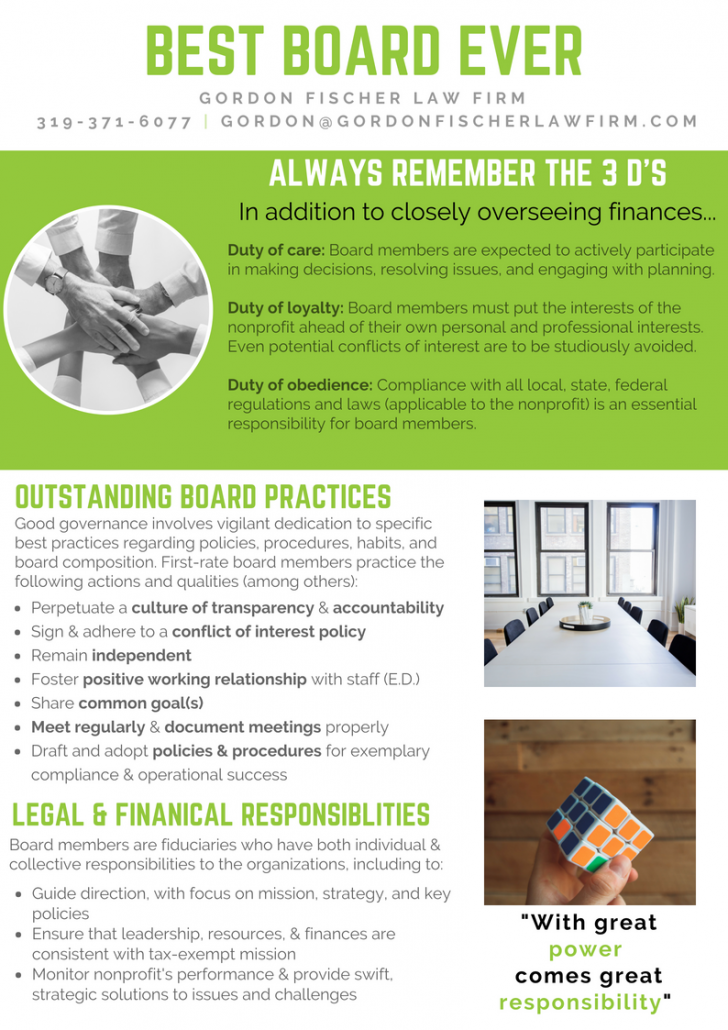
Questions? Thoughts? Need a speaker to present on a topic related to nonprofit formation and guidance or employment law? Don’t hesitate to contact Gordon via email at gordon@gordonfischerlawfirm.com or by phone at 515-371-6077.