
women talking about philanthropy

March is Women’s History Month and to celebrate, I’d like to highlight just a few of the many women who have made their mark on history by practicing smart, impactful charitable giving. Undoubtedly these women believe in advancing philanthropy through “walking the walk” and moving the needle forward on what the modern philanthropy looks like. No longer is philanthropy limited to signing a big check, today’s do-gooders are creative, dedicated, and using social entrepreneurship to draw attention to pressing concerns of the world.

Melinda Gates

Gates, who has received her MBA from Duke, co-founded the Bill & Melinda Gates Foundation in 2000 with her husband. The couple has donated more than $36 billion to different charitable initiatives! Gates has been integral in expanding the reach of the foundation to include areas of focus ranging from global education to developing preventive measures and treatments for life-threatening illnesses, like malaria, tuberculosis, and HIV/AIDS. At the helm of the Foundation, Gates has persistently worked to combat global poverty and has raised awareness about important issues that demand practical solutions like “time poverty.”

Oprah Winfrey

No surprises here! The benevolent media mogul has given hundreds of millions to educational causes (including establishing the Oprah Winfrey Leadership Academy for Girls), endowed her own charitable foundation, and has supported a wide range of other charities ranging in fields from environmental, to arts and culture, to humanitarian. Oprah also regularly uses her platform of fame to encourage her fans/viewers to support charities they care about.

Sara Blakely

Youngest self-made female billionaire and founder of Spanx, Blakely was an early signer of the Giving Pledge, a call to action by founders Bill Gates and Warren Buffett encouraging billionaires to donate at least half of their wealth to charity. Additionally, her company’s foundation supports programs designed to empower underserved women and girls through education, entrepreneurship, and the arts.

Dr. Marilyn Simmons

Simons is president of the Simons Foundation. With a Ph.D. in economics, Simmons was uniquely poised to grow the 1994-established private foundation into a leading funder for math and scientific research.

Dr. Priscilla Chan

As a pediatrician, Chan has incorporated her medical training into the charitable and 501(c)(4) arms of the Chan Zuckerberg Initiative, which operates with ambitious goals such as “to cure, prevent or manage all disease in the next generation’s lifetime.” Also, in 2016, Chan founded The Primary School, a private, nonprofit school in East Palo Alto, California that offers both a high-quality education and healthcare services.


Inspired yet to make your mark and leave a lasting legacy? Of course, this is just a short list. This blog post could go on for days if we let it, as so many women are power players when it comes to charitable collaboration and effective resource management.

Believe me, you don’t need to be wealthy to make a difference and maximize what you can/want to give to your favorite causes and nonprofit organizations. Contact me to discuss strategies that are unique/work for you.


woman in front of painting

If you’re growing an art collection it brings up an interesting situation: how do you incorporate your prized pieces into your estate plan? Sure, you likely don’t have an authentic da Vinci, Renoir, or Klimt just hanging in your living room, but maybe you have a couple of pieces you inherited or a burgeoning modern art collection.

Value of a Passion

For most collectors the art isn’t about monetary value, but more so about a passion for a certain period, artist, or medium. Collecting is often an act of genuine appreciation for the fine arts. Considering both the intrinsic and market value of your art collection it’s ESSENTIAL you include it as a part of your estate plan. The collection is, after all, a part of your total estate’s value and they way it’s handled in your estate plan could impact the value of your gross estate in regards to the federal estate tax. When it comes to the estate planning goal of avoiding such taxes and fees the appraised value of your art is paramount to consider. Naturally, you want your collection to be well-treated following your passing, as well as retain its value.

Let’s go through some important steps and elements to consider.

Assemble Documentation

The value of the collection will be important to the estate plan. If you haven’t done so already, you must correctly catalog, photograph, insure, and appraise the collection. You should also gather all documentation such as appraisals and bills of sale that will need to accompany the artwork as it changes hands upon your estate plan’s execution.

Weigh Your Options

With an art collection, there are three main options for disposition within your estate plan (or to be executed during your life).

Donate

Donating your art to a charitable organization or a museum is an excellent way to practice smart charitable giving. It can also be one of the more simple options. Donate through your estate plan following your death and the estate will receive a tax deduction based on the current valuation. Give while you’re living and you can take an income tax deduction, also based on the value of the piece or collection at the time of the donation.

With this option, you and the recipient organization should agree to signed terms and conditions BEFORE the artwork delivery. Details can include specifics as to where and how the art is to be displayed if you want your name on the signage next to the painting and similar details.

Bequest Artwork to your Loved Ones

Another common option is to keep the art within the family by passing along the art along to your estate’s heirs. Yes, you could gift each individual piece to each family member, but if you want to keep the collection intact you could transfer the collection to a trust you create while living that can be updated and changed during your lifetime. A trust is a solid estate planning tool that allows your named trust beneficiaries to avoid estate tax and probate complications and fees. In the formation of your trust, you can also define the terms for the care and condition of the artwork.

You could instead bequest the collection to an entity like an LLC you create. In this case, your heirs would own interest in the LLC instead of each owning a piece of art. In your estate plan and in the development of the entity you can appoint a manager (or multiple managers) who make sales or purchasing decisions for the collection.

Sell

It goes without saying that art is expensive—to buy and to sell. There are benefits (and detriments) to this option during life and after death, but waiting to sell until after death means the art’s value will be included in the estate. As such the capital gains tax could be lessened or entirely eliminated because the tax basis for the art collection is increased to fair market value at the time of death, instead of what you paid for the art/collection. If you instead would like to sell while alive you can likely expect to pay a capital gains tax on top of a sales commission fee and sales tax (among other potential fees).

Give, gift, sell—whatever option you choose, select a plan that allows you to feel at peace with where and to whom your collection is headed.

Enlist an Expert

Regardless of what option you want to pursue in the disposition of your art work, you need to work with an experienced estate planner who can help navigate the complexity of your estate. It’s your estate planning lawyer who can help you establish a framework for passing along your artwork to your chosen beneficiaries.

Discuss With Your Family

Depending on your family dynamic, discussing your estate plan with your loved ones can be difficult. It can bring up emotion and hard topics like mortality, however, to avoid litigation, mitigate in-fighting, and help determine what’s the best course of action forward for your property it’s necessary. When it comes to your art collection, your heirs may not feel the same way about the artwork that you do and knowing these opinions is critical in the decision of what to do with the collection.

When having the conversation, cultivate an environment in which your family can discuss openly and freely without judgment. You want their honest opinions as a part of your decision in what to do with your collection in the event of your passing.

art graffiti


Just as the art itself can be exceedingly complex, so can incorporating said art into an estate plan. You probably have questions; don’t hesitate to reach out at any time via email or phone (515-371-6077). I offer a free one-hour consultation and would love to help you protect your artistic assets through quality, individualized estate planning.

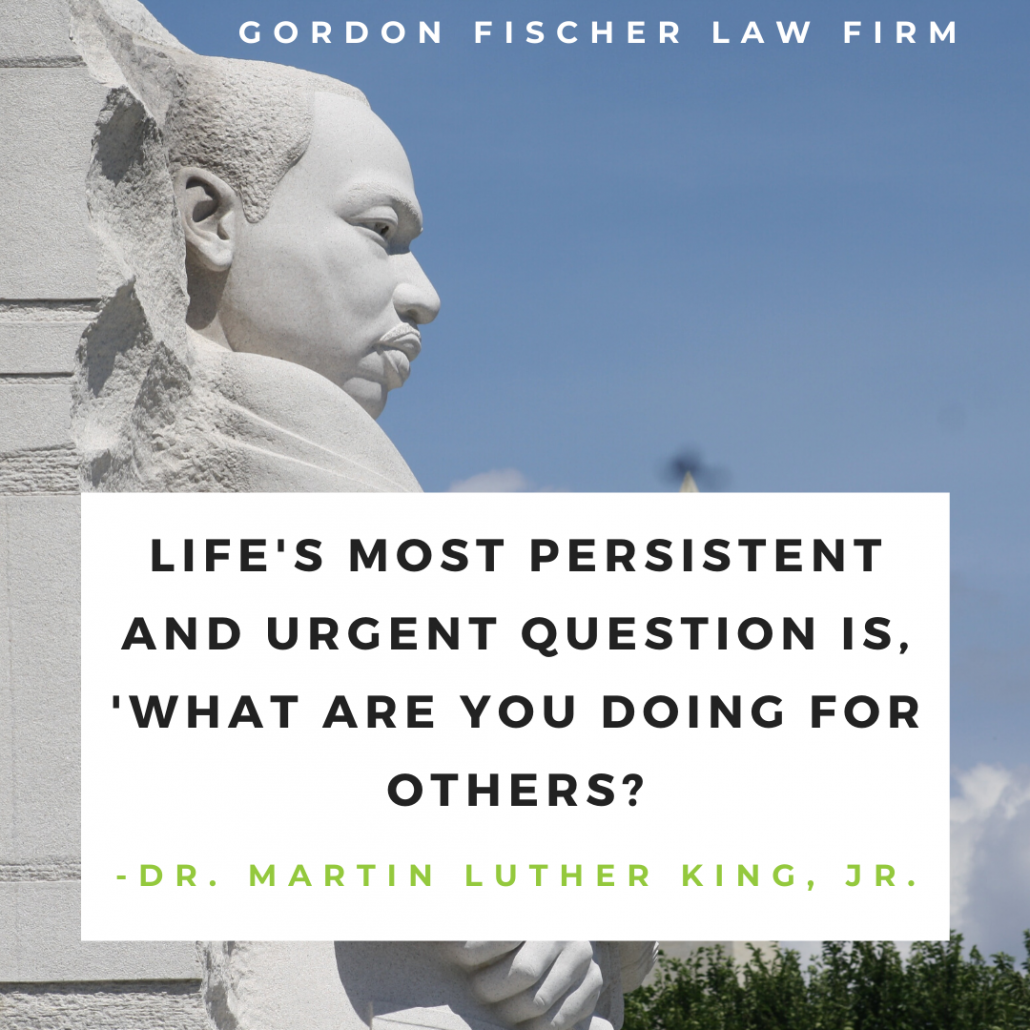
Dr. Martin Luther King Jr memorial

Today we celebrate Dr. Martin Luther King, Jr. and his passion, constancy, and determination in making America live up to its professed ideals and fulfill “the promise that all men, yes, black men as well as white men, would be guaranteed the unalienable rights of life, liberty, and the pursuit of happiness.” His powerful impact belies the brevity of his life—a public career that lasted just a dozen years, from the Montgomery, Alabama, bus boycott in 1956 to the sanitation workers’ strike in the Memphis, Tennessee where he was assassinated in 1968 at the age of 39.

When we think of Dr. King, it’s often of his tireless campaign for racial justice, but that is shortchanging his all-encompassing vision for a better America involving poverty, health, and women’s rights. The social justice reforms he championed and his commitment to nonviolent direct action in order to achieve them led to his receiving the Nobel Peace Prize in 1964. Notably, he donated the entirety of his award — $54,123—to the civil rights movement.

I see Dr. King’s examples of generosity and commitment to the betterment of our world being practiced every day by Iowans who support the nonprofit organizations in their communities through charitable giving. Many ensure their support will continue after even after death, by creating estate plans that include legacies for their favorite charities.

Leaving a legacy is one of the most important things we can do in life because it enables us to carry our influence, our values, and our convictions into the future. Our lives may not have the kind of profound historical impact of Dr. King’s, but our individual legacies are no less consequential to the people we love and the organizations whose missions we care about. What will your legacy be?

What will your legacy be? Don’t hesitate to contact me for a free charitable giving consultation. As Dr. King said: “The time is always right to do what is right.”

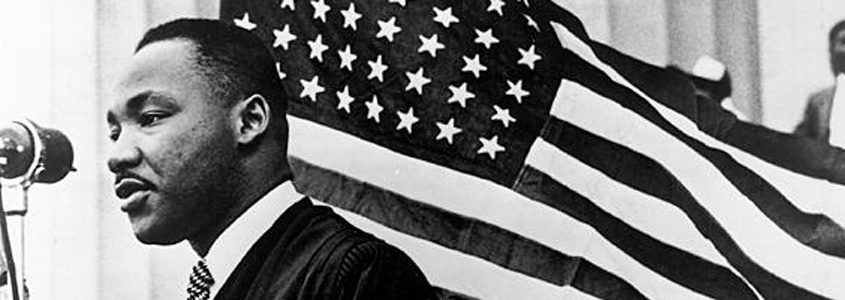
Marting Luther King Jr. and American Flag

Martin Luther King Jr. Day is tomorrow (January 20) I think it’s important to pay tribute to a man who truly championed ideals of equity, freedom, peace, and justice. Among his many accomplishments, Dr. King tirelessly pushed for nonviolent activism and peaceful resolution to human rights issues. He reportedly wrote five books and gave hundreds of speeches in a single year…more than most of us could produce in a lifetime. And, there’s no doubt that he was a key player and influencer in the passage of the U.S. Civil Rights Act of 1964. Dr. King was subsequently was awarded one of the highest honors in the world in 1964—the Nobel Peace Prize—for “his dynamic leadership of the Civil Rights movement and steadfast commitment to achieving racial justice through nonviolent action.” (He donated the prize money, $54,123, back to the civil rights movement.)

Dr. King and his lasting legacy can undoubtedly serve as an inspiration to us all. I see his dream of a better world—a better future for all—exemplified in action by the hardworking Iowa-based nonprofit organizations. I also see his lessons being practiced by the wonderful donors who support these organizations and advance their missions.

So, yes, it’s nice to have a day off of work, but make certain the day doesn’t pass you by without setting a plan in place to perform some form of service for others.

Dr. King tirelessly pursued the advancement of human rights for the greater good and we can honor him by practicing forms of charitable giving as a way to advance our communities. Be it through volunteering time to an organization that speaks to your heart (remember, certain costs associated with volunteer can be tax deductible), setting up a donor-advised fund, or simply writing a list of the nonprofits you would like to include as beneficiaries in your will, you too can set out on an honorable service-oriented path and inspire your friends, family, and colleagues to follow suit.

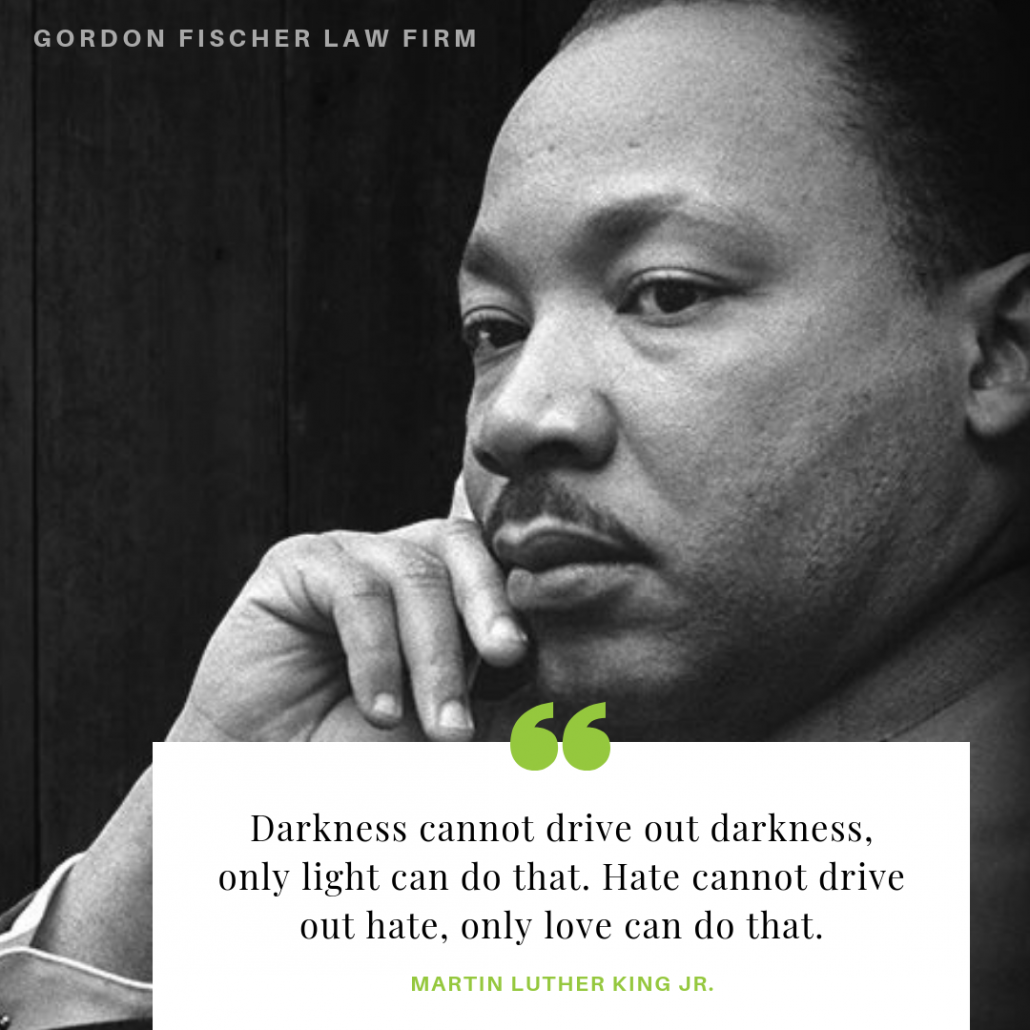
MLK Jr. Day Quote

Dr. King’s lessons resonate with our hearts and heads because we too have dreams of making our corners of the world a better place to learn, live, and grow through service. Maybe Dr. King’s commitment to “practice what you preach” mentality has inspired you this year to give charitably more and more often. Maybe you considered his question, “What’s your life’s blueprint?” and decided to form the charity you’ve wanted to establish for a long time. Either way, don’t hesitate to contact me for a free consultation. As Dr. King said: “The time is always right to do what is right.”

man with fireworks - charitable giving

With ringing in the new year comes the inevitable resolutions to be happier, healthier, more productive…all good intentions. But, what if this year you make a different kind of resolution—an actionable goal that could make a difference in the causes you care about? How about a goal that goes beyond yourself and could also have a positive impact on your community? This year I implore you to make at least one charitable giving goal. A giving goal can be a “resolution” you actually keep after the snow melts. How? With the right plan in place!

woman looking at fireworks

Similarly, I encourage my clients to determine their estate planning goals. These goals help guide me in drafting a personalized estate plan and determining which documents and provisions are needed. After all, every Iowan, family, and business is unique. Charitable giving goals can work the same way as a guiding blueprint for the who, what, when, and why of giving.

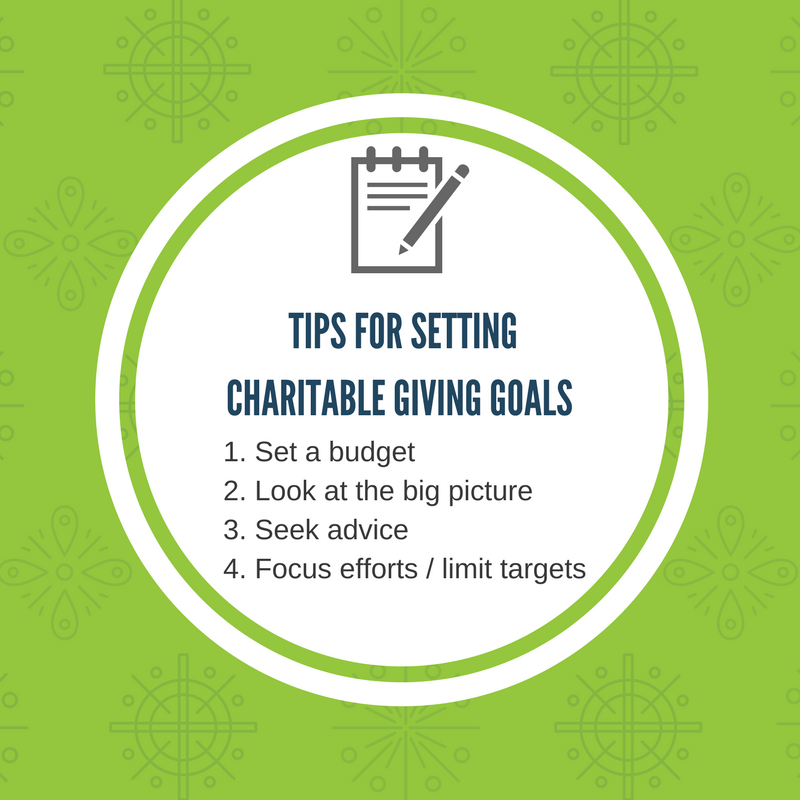
Use the following information to set your charitable giving goals for the new year!  

tips for setting charitable giving goals

Set a budget.

Of course, to begin, you’ll need to examine your entire budget including income, committed expenses (such as rent/mortgage payments, all bills, healthcare costs, etc.), to determine your discretionary income—this is the money you have left over after your committed expenses.

Along with your budget you should also consider whether larger one-time donations or recurring (perhaps monthly) donations work better for your budget, personality, and spending habits. A one-time donation may help prevent money from being spent on other discretionary choices. On the other hand, a repeated, monthly donation may help divide the total amount up into manageable sums. And, monthly donations can often be configured to automatically be made from your account which makes it easy to set the figure at the beginning of the year and make it a regular expenditure. Nonprofit organizations are grateful for all charitable contributions, but recurring, monthly gifts make their budgeting easier.

Look at the big picture.

big picture giving

Step back from the accounting weeds for a moment and sit down with a plain piece of paper. Write down the causes and organizations you care about. If you feel passionate about a certain issue, but don’t know of a specific charity off the top of your head that is addressing the issue, make a note of it. Your list doesn’t have to be long, just true to you.

Then, commit to research to determine which organizations are going to invest your money toward a mission that aligns with your own ethos. Some things to consider about a charity:

  • Financial health. Tax-exempt organizations have to file Form 990 (officially, the “Return of Organization Exempt From Income Tax”)  with the IRS. This form details the organization’s financial information and is available to the public. Do a search on a database such as the Foundation Center, for a charity you’re considering donating to, and review the financial data.
  • What’s the charity’s commitment to transparency? How about accountability?
  • What’s the organization’s Charity Navigator rating, if any? Charity Navigator’s rating system examines a charity’s performance in the areas of financial health and accountability/transparency, and presents it in an easily discernible way.
  • Is the organization a public charity or private foundation? This will have an impact on your federal income tax charitable deductions.
  • Is the organization based in the U.S. or is it a foreign charity? (Generally, if the donee is a foreign charitable organization, an income tax deduction is unavailable.)

Of course, if you’re personally involved with an organization through volunteering, fundraising, or the like, that’s a good way to “know” the charities as well. Research will empower and embolden your charitable goals if you know your donation is going to an upstanding, trustworthy operation.

Seek advice.

If you made a goal to increase muscle mass, you would likely seek the services of a personal trainer. If your goal is to eat healthier? Maybe a nutritionist. When the goal is to be committed to smart charitable donations, you’ll want to enlist the likes of your lawyer, accountant, and/or financial advisor. Seek out a professional who has experience working with nonprofits, the tax code, and strategies for intelligent giving. This pro can and should be able to help you put your plan into action.

(This tip also applies to practicing charitable giving through your estate plan—something you should definitely hire an estate planning lawyer to make sure the estate plan is properly, legally executed.)

Focus efforts / limit charitable targets.

Smart charitable giving means a vested commitment toward a cause or organization’s advancement, as well as financially beneficial tax deductions for you. Unlike investments where the general advice is to diversify to reduce risk, in the realm of charitable giving the opposite may well be true. You may well receive the greatest “return” by concentrating your giving on a fewer, rather than more, organizations. Consider giving to two or three nonprofits to magnify your impact.

If you’re ready to commit to charitable giving goals you can actually keep I’m happy to offer advice and strategy. Don’t hesitate to reach out via email (gordon@gordonfischerlawfirm.com) or by phone (515-371-6077).

We’re now well into the 25 Days of Giving Series and it’s my intent to provide different aspects and strategies of charitable giving. Given that it’s the season of joy, sharing, and love it’s a great time to be thinking about smart giving (the kind that doesn’t involve gift wrappings, stockings, or bows). Read on to learn how the charitable remainder trust could be a valuable giving tool. 

Charitable Remainder Trust, defined

A charitable remainder trust (CRT) is a split interest trust that pays out income to one or more non-charitable beneficiaries for life (or lives) or a term of years not to exceed twenty. The selected payout rate may not be less than 5%, and no more than 50%, of fair market value (FMV) of assets originally placed in trust. At the end of the trust term, the remaining trust assets (the remainder interest) is distributed to charity selected by the donor; the actuarial value of the charity’s remainder interest must be at least 10% at the time of the trust’s creation.

Benefits of a CRT

  1. Note that a useful attribute of a CRT is flexibility. Although Donor’s transfer of property to the trust is irrevocable, a CRT provides for Donor the right to change charitable beneficiaries.
  2. Note also the tax benefits of a CRT. Donor may receive a federal income tax charitable deduction for the value of the remainder interest in the year of the transfer, Donor may transfer assets without recognition of capital gain tax, and there is no estate tax on the property passing to Charity.

Two forms: CRAT and CRUT

CRTs take one of two forms: a charitable remainder annuity trust (CRAT) or a charitable remainder unitrust (CRUT). There are important differences:

A CRAT pays an annuity to the income beneficiary at a selected payout rate that is a percentage of the assets valued at the time of the trust creation. Additional contributions to the trust are not permitted.

A CRUT pays a percentage of the annual value of the trust assets, a unitrust amount, to the income beneficiary. Additional contributions to the trust are permitted.

Variations of CRUTs

Several variations of the CRUT are permitted under the Internal Revenue Code:

  1. A Net-Income CRUT (NICRUT) permits the trustee to distribute an annual payment that is the lesser of the specified percentage of value in that year, or the net income actually earned by the trust in that year.
  2. A NIMCRUT is a CRUT with a net-income limitation subject to a make-up provision. Like a NICRUT, the terms of a NIMCRUT direct the Trustee to pay the lesser of the specified percentage of the value of the trust assets in that year or the net income actually earned by the trust in that year. However, if the payout is less than the specified percentage is paid out in one or more years, the accumulated “income deficits” will be made up in a subsequent year from the excess income above what is the specified percentage of the value of the trust assets in that year.
  3. A Flip CRUT permits the trust to begin its existence as a NICRUT or NIMCRUT, then “flip” into a standard CRUT on the occurrence of a specific triggering event, as provided in the trust document. The flip option is attractive when Donor wishes to donate to the CRUT illiquid or hard-to-market assets, such as real estate or closely held stock.


butterfly on finger

​Knowing if the CRT is a best choice for your charitable giving can be difficult, so I advise speaking with your trusted professional advisors to evaluate your situation. This concept can be confusing, so don’t hesitate to reach out for more information and explore how a charitable remainder trust could be beneficial to you. Feel free to contact me at any time at Gordon@gordonfischerlawfirm.com or by phone at 515-371-6077.

Santa with Heart

Thanks for reading the 25 Days of Giving series! Share with friends, family, & colleagues to inspire others to also make meaningful year end gifts this season…and plan ahead for 2020 charitable goals.

Under the current tax code, you may have changed the ways in which you give or the tax-beneficial strategies you employ with your charitable giving as compared to previous tax laws. What hasn’t changed, is that you may choose to deduct from your federal income tax any charitable contributions of money or property made to qualified organizations if you itemize your deductions. But, there are record keeping requirements you’ll want to stay on top of, so you’re not scrambling during tax time!

Payroll deduction substantiation

Making a charitable deduction directly from your paycheck is a great and steadfast way to be sure to meet your charitable giving goals. For charitable contributions made via payroll deductions, the donor needs two documents to substantiate the gift:

  1. a pay stub, W-2, or other document furnished by the employer that sets forth the amount withheld from the taxpayer during a taxable year by the employer for the purpose of contributing to a charity;
  2. a pledge card or other document prepared by or at the direction of the charity that shows the name of the charity.

Donors who give to a local United Way or other organizations that funnel contributions to other charities need to only obtain the pledge card or other document from the United Way and not from the affiliated charities which ultimately receive the money.

Payroll deductions of $250 or more

Tax law requires that for any contribution of $250 or more, the taxpayer must substantiate the contribution by a contemporaneous written acknowledgement of the contribution by the charity. For payroll deductions, the contribution amount withheld from each payment of wages to a taxpayer is treated as a separate contribution for purposes of the $250 threshold.

So, for example, a taxpayer who gave $300 over the course of a year through payroll deductions, $30 per paycheck over ten paychecks, would not trigger the $250 substantiation requirement. The substantiation requirement would only kick in if $250 or more is withheld from each paycheck.

If any of this is confusing, know you don’t have to navigate these requirements just by yourself. Contact me at any time to discuss your situation and charitable giving goals. We’ll figure out the best course of action together!

charitable gift tax limits - hand holding christmas gift

If you choose to itemize your taxes, charitable contributions can reduce your tax bill. Generally you would choose to itemize when the combined total of your anticipated deductions (like charitable gifts) add up to more than the standard deduction. For 2019 taxes the standard deductions are:

  • $12,200 for single individuals
  • $12,200 for married, filing separately
  • $24,400 for married filing jointly
  • $18,350 for head of household

If you do choose to itemize, limits on federal income tax charitable deductions are quite high, but they do exist. Keep this in mind as you make any year-end donations. The specific limitations are complicated, and there are numerous exceptions. The limits are based on your AGI (adjusted gross income). AGI is an individual’s total gross income minus specific deductions.

A quick rule-of-thumb for different types of donated assets to public charities:

  • Appreciated capital gains assets (such as stock) up to 20% of AGI
  • Non-cash assets up to 30% of AGI
  • Cash contributions, up to 60% of AGI
  • You can deduct transportation costs and other expenses related to volunteering

Note that these rates are for public tax-exempt organization and private operating foundations. Contributions to certain private foundations, veterans organizations, fraternal societies, and cemetery organizations are limited to 30% adjusted gross income. (Check out these IRS status codes and deductible limits if you’re unsure of an organization’s limit.)

As I mentioned, most people won’t exceed these limits indicated above, but it can happen. For instance, if Jane Donor is a retiree living off of savings and donates more than her investments yield over the year, her limit could be exceeded. The good news is that in this case the IRS allows you carry over excess contributions for up to five following tax years.

Don’t forget to take these steps if you plan to itemize your charitable deductions:

  • Make sure the nonprofit organization is a 501(c)(3) public charity or private foundation
  • Keep a record of the contribution (usually the tax receipt from the charity)
  • Depending on the donation amount/type, you may need to obtain a qualified appraisal to substantiate the claimed value of the deduction
  • Subtract the value of any benefits you received for your charitable contribution before you deduct it

I’m happy to advise on your situation and help you maximize your charitable giving for this tax year. I can be reached by phone at 515-371-6077 and by email at gordon@gordonfischerlawfirm.com.

woman holding ornament

Thanks for reading the 25 Days of Giving series. Each day through December 25, I’m covering different aspects of charitable giving for both donors and nonprofit leaders. Have a topic you want to be covered or questions you want to be answered regarding charitable giving? Contact me.

I’ve covered the term quid pro quo in a previous legal word-of-the-day blog post and much of that applies to understanding quid pro quo donations. In short, quid pro quo (now you know Latin!) translates to “something for something” and means an exchange of goods or services, where one transfer is contingent upon the other. In the case of nonprofit organizations, sometimes a good or service is offered in exchange for a donation. When the donor makes a charitable donation more than $75 and the nonprofit offers a good or service in exchange for said donation, the tax-exempt charity must provide a written statement to the donor disclosing the following:

  • Statement of the good(s) or service(s) received in exchange for the donation.
  • A fair market value (FMV) of the good(s) or service(s) received.
  • Information for the donor that only a portion of the total contribution (the portion that exceeds the FMV) is eligible for a federal income tax charitable contribution deduction.

What Nonprofits Need to Know

merry christmas event menu

As a nonprofit organization offering a quid pro quo donation situation, there’s a penalty for not making the required disclosure of contributions greater than $75. The penalty is $10 per contribution up to $5,000 per fundraising mailer or event. If your nonprofit fails to disclose, but can prove the failure was due to a reasonable cause, the penalty may be avoided.

Offering a good or service as an incentive for a donation can be a great way to spark donor interest, but you’ll definitely want to determine the FMV and have a reasonable method, applied in good faith, for doing so. This can be easier said than done for goods and services that are not generally or commercially available. If that’s the case it’s recommended to estimate the FMV off of similar/comparable products and services that are available. Let’s consider a couple examples:

Example 1. For a contribution of $20,000 a history museum allows a donor to hold a private event in a ballroom of the museum. The museum doesn’t typically rent out this room, so how can a FMV be determined if there’s no standard rate? Looking at other similarly sized and quality ballrooms in the surrounding, general area cost $3,000 a night to rent. So, even though the museum’s ballroom has unique artifacts, a good faith estimate of the FMV of the museum’s ballroom is $3,000. The donor would then have a charitable contribution deduction total of $17,000.

Example 2. Your charity offers a one-hour golf lesson with a golf pro at the local country club to anyone who donates $500 or more. Usually the golf pro can be hired for a one-hour lesson for $100. An estimate made in good faith of the lessons’s FMV is $100.

Example 3. What if the service offered is unique, but is typically free? A state park foundation fundraiser advertises that a donation of $200 or more entitles you a spot on one of four different guided nature hikes with a volunteer park ranger. Typically the foundation doesn’t offer guided hikes to the general public, but hiking in the state parks is otherwise free. So, the FMV made in good faith for the hike is $0 and the charitable contribution eligible for deductions would be the full amount.

The only time you wouldn’t need to disclose the quid pro quo donation is when the good(s) or service(s) are of insubstantial value. The IRS also says disclosure is not required when the donor makes a payment of $75 or less (per year) and the exchange is only membership benefits that equate to, “Any rights or privileges (other than the right to purchase tickets for college athletic events) that the taxpayer can exercise often during the membership period, such as free or discounted admissions or parking or preferred access to goods or services.” The contribution can also stay undisclosed if the good/service is, “Admission to events that are open only to members and the cost per person of which is within the limits for low-cost.”

Basics of What Donors Need to Know

woman in winter with scarf

As a donor, if you’re making a contribution to an organization and receive something in exchange, know that it’s almost like you’re paying for the good/service you receive, but then can deduct the rest of the contribution.

Let’s say you make a charitable contribution of $100 to a 501(c)(3) organization that helps mistreated farm animals. To celebrate their anniversary, the organization is offering donors that gift $80 or more a large coffee table book filled with stories, poems, and photographs of the animals the organization has helped over the years. The book’s fair market value is $30. This FMV is based on the price if you were to buy it outright from the organization’s online shop. In this situation you as a donor would need to receive a written disclosure detailing your contribution amount ($100), FMV of the good (the book) received ($30), and the portion that is considered a tax-deductible charitable contribution amount ($70).

Even though the tax-deductible charitable contribution amount is $70 (less than the $75 threshold), the total donation was $100, so the charity is still required to provide a written disclosure.

Whether you’re a donor or a nonprofit leader, I’m here to help promote and maximize charitable giving in Iowa. Questions about written disclosure compliance or FMV calculation? Don’t hesitate to contact me.

red ornaments Endow Iowa Tax Credit

 Thank you for reading the 25 Days of Giving series! In the spirit of the holiday season, I’m covering different aspects of charitable giving…perfect to get you thinking about your end-of-year giving.

There are many, many reasons Iowa is a great place to live and work. One reason is the Endow Iowa Tax Credit Program—a smart way to stretch your charitable dollars. Iowa community foundations provide exclusive access to the Endow Iowa Tax Credit program. Giving through the Endow Iowa program allows Iowa taxpayers to receive a 25% Iowa tax credit, in addition to the federal charitable income tax deduction, for qualifying charitable gifts.

The Endow Iowa Tax Credit Program provides unique opportunities to meet philanthropic goals while receiving maximum tax benefits. Highlights of this program include:

  • A variety of gifts qualify for Endow Iowa Tax Credits including cash, real estate, grain, appreciated securities, and outright gifts of retirement assets. In fact, appreciated assets, like stocks or real estate, can provide even better value because the donor may avoid capital gains taxes.
  • To be eligible, Endowed Tax Iowa Credit gifts must be placed in a permanent endowment fund of a qualifying organization. The endowment funds are intended to exist in perpetuity (continual), and the spend rate from the fund may not exceed 5% annually.
  • Tax credits of 25% of the gifted amount are limited to $300,000 in tax credits per individual for a gift of $1.2 million, or $600,000 in tax credits per couple for a gift of $2.4 million, assuming both are Iowa taxpayers.
  • Eligible gifts will qualify for credits on a first-come/first-serve basis until the yearly appropriated limit is reached. If the current available Endow Iowa Tax Credits have been awarded, qualified donors will be eligible for the next year’s Endow Iowa Tax Credits. Donors should be encouraged to act as early in the year as possible to ensure receipt of credits as soon as possible.
  • All qualified donors can carry forward the tax credit for up to five years after the year the donation was made.

It should also be noted that the Endow Iowa Tax Credits are capped. The Iowa Legislature sets aside a pool of money for Endow Iowa, and it’s available on a first-come, first-serve basis. Submitting an application at the beginning of the tax year is advised, as tax credits often run out toward year’s end. In fact, this year approximately $6 million in tax credits were awarded and there are no more available credits to be granted. However, you can submit your application to be placed on the waitlist for 2020 tax credits.

In exchange for 25% Iowa tax credit and the opportunity to have an even greater impact on their philanthropic interests in the state of Iowa, now and into the future, the Endow Iowa Tax Credit Program should be seriously considered by all. The impact is immense: in 2018, donors received tax credits for more than 3,434 separate donations to 76 different community foundations and affiliate organizations through Endow Iowa. And, since 2003, more than $263 million has been invested through the program to improve residents’ lives.

Any questions or thoughts on how the Endow Iowa Tax Credit Program could mean big benefits for your finances and your state? Don’t hesitate to contact me.