
Posts

WNBA Opening Night: Five Things Iowa Nonprofits Can Learn From Ballers. Showing a basketball hoop.

WNBA Opening Night: Five Things Iowa Nonprofits Can Learn From Ballers

May 8, 2026

By Gordon Fischer

WNBA opening night is Friday, May 8. Three games Friday, three more Saturday, and a five-game Sunday slate.

Thirtieth season. Two new teams: Toronto and Portland. A new CBA the players actually voted for. The Aces enter the season having won sixteen straight regular-season games to close out 2025. Caitlin Clark and Paige Bueckers on the same floor Saturday (noon on ABC). I mean, come on.

Before I continue: if you like the W and you don’t already listen to the awesome podcast HomeStans, go subscribe. It’s a mother-daughter podcast, Mia Hunt and her mom Christine Selk, and they’re sharp, they’re funny, and they actually watch the games. You can find them on Spotify, on Apple Podcasts, and on Audible. Subscribe, listen, leave a five-star review. The review part matters more than people realize, as indie podcasts move up and down in the algorithm based on that stuff, and it costs you maybe thirty seconds of your life.

Anyway, the point of this post: I have been doing nonprofit law for a long time now, and watching basketball for longer than that, and at some point a few years ago it occurred to me that the nonprofits I was helping and the teams I was watching had way more in common than either group knew. So here are five things – five, because I had to stop somewhere, that Iowa nonprofit boards could stand to learn from a good basketball team.

1. Everybody has a position. Play yours.

You generally don’t see Caitlin Clark setting screens in the post. You generally don’t see A’ja Wilson running point full time. Not because either of them couldn’t do it. Ultra-elite athletes can do a lot of things, but because that’s not the job. The point guard runs the offense. The center protects the rim. Roles.

Most board dysfunction I see, and I see a fair amount, comes down to people not knowing what their job is or, worse, drifting out of position. The chair starts second-guessing the executive director’s day-to-day. The treasurer wants to weigh in on programming. A board member who is really passionate about the new website redesign starts emailing the staff directly. It’s all coming from a good place. It also breaks the offense.

If your board hasn’t sat down and written out, in plain English, what each officer does and doesn’t do and what the full board does versus committees versus staff, that’s the first thing. It’s not glamorous work, but it pays for itself the first time you avoid a turf battle.

2. Coaches coach. Players play. Refs ref.

Picture Becky Hammon grabbing the ball in the middle of a possession to take a shot herself. You can’t picture it because it doesn’t happen. The coach coaches. The players play. The refs do their thing, and we all yell at them, and that’s how it works.

Same setup at a nonprofit. The board is the coaching staff. They set the strategy, they hire and evaluate the executive director, they watch the financials. The ED and the staff are the players, they actually run the programs and do the work. Counsel and the auditors are, in this metaphor, the refs. They keep you in bounds.

The trouble starts when a board decides it wants to play. Editing the staff’s newsletter copy. Rewriting the program calendar. I once had a board chair tell me, with a straight face, that she liked to “drop in unannounced” at the office to see how things were going. Reader: do not do this. Govern the organization. Let the staff run it.

3. Have a playbook. (Yes, this means policies.)

I know, I know. Policies. The least exciting part of running a nonprofit, right behind “reconciling the bank statement.” But every team in the W has a playbook, because freelancing every possession is a really good way to lose.

Your playbook is your policies: conflict of interest, document retention, whistleblower, gift acceptance, financial management, public disclosure, executive compensation. Some of these the IRS asks about on the 990, others are just best practice, and all of them seem like overkill until the day they aren’t. A donor wants to make a gift that benefits a board member’s company. An employee gets fired and threatens to sue. A reporter calls. The IRS wants to chat. In every one of those moments, the policy you had a lawyer write, voted on, trained on, and actually followed is the thing that saves you.

Quick test: pick any board member at random and ask them to name three of your policies. If you get blank stares, that’s a clue.

4. Don’t skip the preseason.

WNBA preseason ran from April 25 to May 3 this year. Nine days of practice, scrimmages, and rookies trying to learn the system before any of it counts. Nobody walks onto the floor on opening night cold.

And yet, I cannot tell you how many boards I’ve worked with that recruit a new director, the director says yes, and the next thing that happens is them showing up to a meeting where everybody else already knows the issues, the players, the inside jokes. They sit there for 45 minutes trying to figure out what an FFA is or who Marie is or why everybody hates the landlord. By the third meeting they’ve checked out.

Onboarding doesn’t have to be elaborate. The articles, bylaws, and policies. The last couple years of financials and 990s. The strategic plan, if you have one (and if you don’t, that’s its own blog post). A coffee with the board chair. A coffee with the ED. A program tour. That’s a couple of hours of someone’s time, max, and it makes the difference between a board member who contributes by month two and one who’s still treading water at month eight.

5. Build a bench.

The Aces won sixteen in a row to end last season. Phenomenal. But A’ja Wilson can’t play 40 minutes a night for 44 games, and she didn’t, because Vegas has a bench. That’s the difference between a good team and a championship team, you can lose your starter and not lose the season.

So I’ll ask the question I ask every board I work with: what happens if your chair has to step down tomorrow? What if your ED gets a better offer? What if your treasurer, the one who actually understands the budget, moves to Phoenix? If the honest answer is some version of “oh god,” you’ve got a depth problem.

The fix isn’t fancy. A real succession plan for the ED, in writing, that everybody on the board has read. A vice president who’s being prepared to be president, not just somebody filling the slot. Committee chairs who are bringing along the next committee chair. Term limits that actually move people through the rotation instead of letting the same five people serve forever (and burn out and quietly resent it). You build the bench when you don’t need it. By the time you need it, it’s too late.

One more thing

None of this is rocket science. Honestly, none of it is even basketball science! It’s just paying attention to the boring fundamentals while the highlight-reel stuff is happening around you like the new building, the big grant, the gala, whatever. The fundamentals are what hold you up when the highlight stuff goes sideways, which it always eventually does.

Tip-off is Friday. Go Fever. Go Tempo. Go Fire. Go everybody! And if you get a chance this weekend, between quarters, or between games, take a hard look at your nonprofit’s positions, playbook, preseason, and bench, and ask yourself which one you’ve been ignoring. Then fix that one first.

If you work with an Iowa nonprofit and reading this made you wince about positions, playbook, preseason, or bench, I offer a genuine free one-hour consultation to any Iowa nonprofit. No strings, no pitch at the end, no funnel.

📧 Email gordon@gordonfischerlawfirm.com. Tell me which of the five you’ve been ignoring. We’ll work on it together.


February 6, 2026

Why Every Nonprofit Needs a Clear Document Retention Policy

Strong nonprofits are built on strong systems. One of the most important — and often overlooked — systems is a Document Retention Policy.

Managing information may not feel urgent compared to fundraising or programming, but it is foundational. A thoughtful Document Retention Policy protects your nonprofit’s legal compliance, operational efficiency, and long-term stability.


A solid Document Retention Policy doesn’t just organize your files — it strengthens your nonprofit’s efficiency, privacy protections, and legal compliance.

What a Document Retention Policy Does

At its core, a Document Retention Policy creates clarity and consistency.

It establishes:

  • What types of records your nonprofit keeps

  • How long each category of record is retained

  • How documents are labeled and stored

  • How and when records are securely destroyed

This applies to both physical records (such as contracts, board minutes, and financial statements) and electronic records (including emails, databases, and cloud-based documents).

Without written standards, organizations often rely on informal practices. Some records are kept indefinitely. Others are deleted too quickly. Over time, that inconsistency can create risk and confusion.

A written policy eliminates guesswork.

Why This Matters for Governance

A Document Retention Policy plays a central role in responsible nonprofit governance.

When properly implemented, it helps your organization:

  • Meet federal and state legal requirements

  • Protect sensitive and confidential information

  • Improve workflow and document accessibility

  • Strengthen organizational accountability

Clear retention timelines prevent both over-retention and premature destruction of important records. They also ensure that, when documents are requested by regulators, auditors, or stakeholders, your nonprofit can respond efficiently and confidently.

Effective record management reflects effective leadership.

Compliance is not accidental — it is structured.

A Document Retention Policy provides the framework that allows your nonprofit to manage information responsibly and consistently. When boards and staff understand what must be kept, for how long, and how it should be handled, the entire organization benefits.

What a Strong Policy Includes

A comprehensive Document Retention Policy should:

  • Identify the categories of records maintained by the nonprofit

  • Specify minimum retention timelines for each category

  • Describe labeling and storage procedures

  • Outline backup practices for electronic records

  • Explain how documents are securely destroyed when retention periods expire

The goal is to create a system that is practical and workable while still firm enough to ensure compliance.

When expectations are clear, day-to-day operations become smoother — and leadership can focus on advancing the mission.

The Bottom Line

If your nonprofit is reviewing its governance policies, a Document Retention Policy deserves attention.

It supports transparency.
It promotes accountability.
And it reinforces your organization’s commitment to responsible management.

Strong governance requires more than good intentions — it requires structure.

Need Help Creating or Updating Your Policy?

The Gordon Fischer Law Firm can help Iowa nonprofits with: drafting, revising, and editing the ten governance policies expressly referenced by the IRS on Form 990 — including Document Retention Policies — tailored to your mission and operations.

📧 Email: gordon@gordonfischerlawfirm.com

January 26, 2026

Before we get into what makes a good Whistleblower Policy, here are four real-life examples of why nonprofits need them:

  1. A long serving bookkeeper notices unexplained reimbursements approved by the executive director but fears reporting them because the director controls her job.
  2. A volunteer becomes aware that restricted donor funds are being used for unrelated expenses but does not know who to tell or whether speaking up could jeopardize their role.
  3. A staff member witnesses repeated harassment by a senior manager and worries that reporting the behavior will quietly end their career at the organization.
  4. A board member learns that required filings have not been made for several years and is concerned about personal liability if the issue is ignored.

In each of these situations, wrongdoing continues not because people are unaware of it, but because they do not feel safe reporting it. A clear Whistleblower and Retaliation Protection Policy is designed to solve exactly this problem.

As a member of a nonprofit organization, wouldn’t you want to know if someone inside the organization was acting illegally, unethically, or contrary to its mission? Nonprofits exist to serve the public good and depend heavily on trust, transparency, and ethical conduct. Yet studies consistently show that reporting drops sharply when organizations lack a clear and credible whistleblower policy.

A well drafted Whistleblower Policy creates a structured, trusted process for raising concerns. It protects individuals who come forward, helps leadership address problems early, and reduces
legal and reputational risk. This blog post explains what a whistleblower policy is, why it matters, who it protects, how it works in practice, and the best practices every nonprofit should consider adopting.

What It Means to “Blow the Whistle”

To “blow the whistle” means to report suspected wrongdoing within an organization. A whistleblower policy establishes formal guidelines for employees, board members, volunteers, and others to follow when they become aware of potential misconduct.

The goal is not punishment. The goal is early detection, accountability, and correction before harm spreads. Effective policies encourage reporting by assuring individuals that they can raise
concerns without fear of retaliation, job loss, or reputational damage. Federal and state laws across the United States reinforce this principle by protecting whistleblowers from retaliation and encouraging internal reporting before problems escalate.

Legal Framework and IRS Expectations

Federal law explicitly protects whistleblowers. Section 1107 of the Sarbanes-Oxley Act, codified at 18 U.S.C. § 1513(e), makes it a federal crime to knowingly retaliate against a person for providing truthful information to law enforcement about a possible federal offense. Penalties can include fines and imprisonment of up to ten years, and the law also prohibits destruction of evidence.

Practically speaking, this means nonprofit leaders must take whistleblower complaints seriously, preserve documents, and avoid any actions that could be perceived as retaliation, even indirectly. Iowa law reinforces these principles. The Iowa Nonprofit Corporation Act, Iowa Code chapter 504, imposes fiduciary duties of care, loyalty, and obedience on directors and officers. When credible concerns about misuse of funds, conflicts of interest, or legal noncompliance are raised and ignored, directors and officers risk breaching those duties. A whistleblower policy provides a documented process for receiving and addressing concerns, which can be critical in demonstrating that leadership acted prudently and in good faith.

Iowa nonprofits should also be mindful that retaliation claims may arise under Iowa common law, Iowa civil rights statutes, and federal employment laws applied in Iowa courts. Even volunteers and independent contractors may assert claims when adverse actions follow protected reporting.

The Internal Revenue Service reinforces these expectations through Form 990. Although a whistleblower policy is not technically mandatory, the IRS asks whether one exists and treats it as a hallmark of good governance. To meet the Form 990 standard, the policy must clearly state that the organization protects individuals who report suspected violations of law or organizational policy in good faith.

Why Whistleblower Policies Are Essential for Nonprofits

Nonprofits rely on public trust, donor confidence, and community credibility. This is especially true in Iowa, where many nonprofits operate in close-knit communities and rely on long-term relationships with donors, volunteers, and local stakeholders. Many Iowa nonprofits advocate publicly for accountability, fairness, and ethical conduct. That mission is undermined if similar misconduct is tolerated internally or handled informally behind closed doors.

A strong whistleblower policy helps Iowa nonprofits:

  • Identify problems early, when they are easier and less costly to fix
  • Reduce the risk of regulatory scrutiny by the IRS, Iowa Attorney General, or Iowa Secretary of State
  • Demonstrate that directors and officers are fulfilling their fiduciary duties under Iowa law
  • Protect staff, volunteers, and board members from retaliation
  • Preserve public trust in smaller communities where reputational harm can spread quickly

Without a clear policy, individuals may stay silent, misconduct may continue unchecked, and organizations may face far greater legal, financial, and reputational consequences later.

Who the Whistleblower Policy Is For

A whistleblower and retaliation protection policy should apply broadly. It should cover:

  • Employees
  • Officers and directors
  • Volunteers
  • Independent contractors
  • Vendors
  • Clients and other stakeholders

Even organizations with no paid staff need whistleblower protection. Volunteers often have direct access to sensitive information and must feel safe raising concerns.

When and Where to Report Misconduct

Concerns should be reported as soon as reasonably possible. Prompt reporting allows the organization to stop ongoing harm, preserve evidence, and respond appropriately. Best practice policies provide multiple reporting channels, such as:

  • A direct supervisor
  • Another manager or officer
  • A designated ethics or compliance contact
  • The board chair or audit committee
  • An external or anonymous reporting mechanism

Multiple options are essential, especially when the concern involves a supervisor or senior leadership.

Covered Wrongdoing

A well drafted policy clearly defines the types of conduct that may be reported, including:

  • Fraud or financial misconduct
  • Theft or misuse of organizational assets
  • Violations of law or regulations
  • Conflicts of interest
  • Discrimination or harassment
  • Violations of confidentiality obligations
  • Unsafe or unhealthy working conditions
  • Abuse of authority
  • Retaliation against whistleblowers

Clear definitions reduce uncertainty and encourage reporting.

Reporting Procedures

Effective policies explain how to report concerns and make the process accessible. Best practices include:

  • Clear written reporting instructions
  • Options for confidential or anonymous reporting
  • Identification of who receives and reviews reports
  • Escalation paths if concerns are not addressed

Good documentation protects both the whistleblower and the organization.

Investigation Procedures

Once a report is received, the organization must act promptly and responsibly. The policy should describe:

  • How investigations are initiated
  • Who conducts them
  • How evidence is collected and preserved
  • Expected timelines
  • How findings are documented and addressed

Investigations should be objective, thorough, and conducted by individuals with appropriate independence and authority.

Confidentiality

Confidentiality is critical to effective whistleblower protection. Policies should commit to maintaining confidentiality to the greatest extent reasonably possible. While absolute confidentiality cannot always be guaranteed, especially if legal proceedings follow, failing to promise confidentiality at all will strongly discourage reporting.

Protection Against Retaliation

The policy must clearly prohibit retaliation. Retaliation includes termination, demotion, harassment, intimidation, reduced hours, or any adverse action taken because someone reported
concerns in good faith. Anyone who retaliates should face discipline, up to and including termination or removal from office or board service.

Good Faith Reporting and False Allegations

Whistleblowers must act in good faith and have reasonable grounds to believe misconduct has occurred. Knowingly false or malicious allegations should result in discipline. Importantly, an allegation that cannot be substantiated does not mean it was made in bad faith.

Disciplinary Action and Outcomes

Policies should outline potential consequences when allegations are substantiated, including corrective action, discipline, or termination. They should also address consequences for retaliation and bad faith reporting.

Training and Communication

This is critical. A whistleblower policy is ineffective if people do not know it exists or how to use it.

For Iowa nonprofits, this section should align closely with other governance disclosures and practices reflected on IRS Form 990, including policies addressing conflicts of interest, document retention and destruction, compensation review, and Form 990 review and approval itself. The IRS looks at governance holistically, not in isolation. Best practices include:

  • Distributing the policy during onboarding
  • Providing periodic training
  • Including the policy in employee handbooks
  • Training investigators on process and confidentiality

Consistent implementation across these policies strengthens credibility if the organization’s governance practices are ever reviewed by the IRS or state regulators.

Support for Whistleblowers

This is equally important. Whistleblowers often experience stress, fear, or emotional strain. Providing access to support resources demonstrates a genuine commitment to ethical culture and
reinforces trust.

Policy Review and Updates

Whistleblower policies should be reviewed periodically and updated to reflect changes in law, organizational structure, and best practices.

Conclusion

A well designed whistleblower and retaliation protection policy is a cornerstone of strong nonprofit governance. It protects individuals, strengthens organizational integrity, and reinforces public trust.

For Iowa nonprofits, whistleblower protection should be viewed alongside other core governance practices reported on IRS Form 990, including conflict of interest policies, document retention policies, compensation approval processes, and board oversight procedures. These policies work together to demonstrate that directors and officers are meeting their fiduciary obligations under Iowa law.

Nonprofits should not treat whistleblower policies as boilerplate or check-the-box documents. They should be tailored to the organization’s structure, actively implemented, and supported by leadership.

I advise Iowa nonprofits on governance, compliance, and risk management. I work with Iowa charities, churches, foundations, associations, and membership organizations to draft, review, and align whistleblower policies with Articles of Incorporation, Bylaws, Form 990 disclosures, and the full suite of IRS-recommended governance policies.

If your Iowa nonprofit needs assistance drafting, reviewing, or updating a whistleblower policy or strengthening its overall Form 990 governance framework, contact me anytime. I offer free consultations. My email is: gordon@gordonfischerlawfirm.com

January 22, 2026

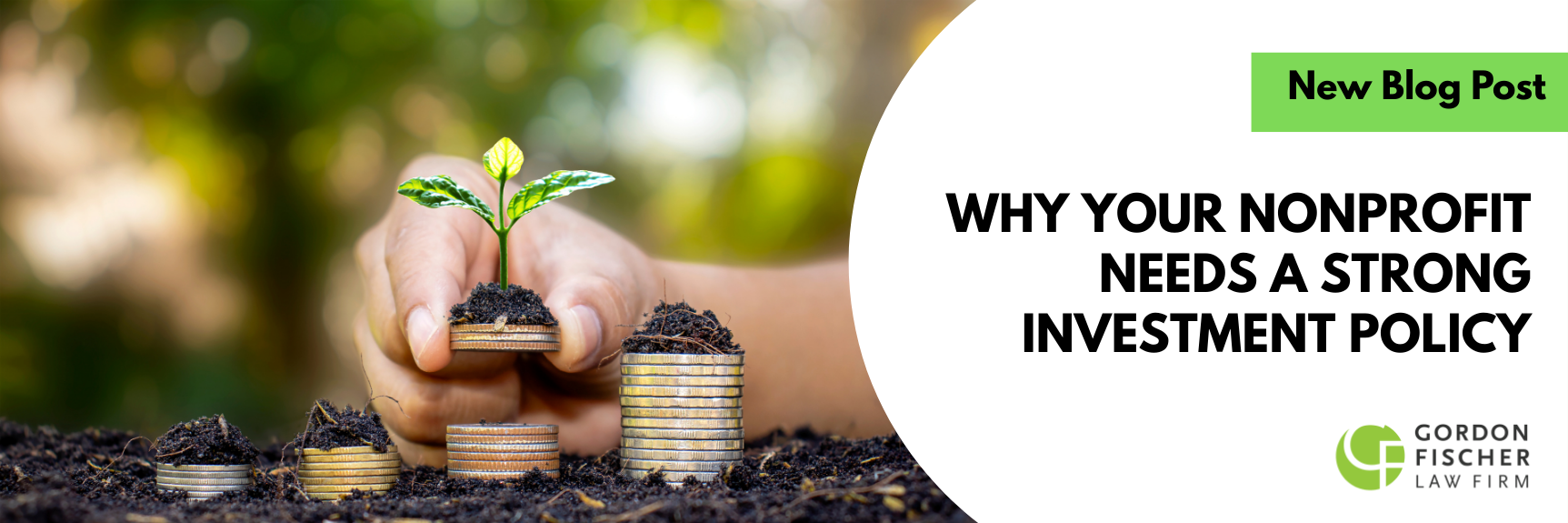
If your nonprofit holds financial assets—whether as operating reserves, short-term funds, or long-term endowments—having a written Investment Policy is essential for responsible stewardship and sound governance.

What is an Investment Policy?

An Investment Policy is a formal set of guidelines that explains who makes investment decisions, how those decisions are made, and what goals and limits guide investment activity. It provides clarity on acceptable asset types, risk tolerance, reporting expectations, and the procedures your organization uses to manage and monitor investments.

A well-crafted policy should:

  • Align investment activity with your mission and financial needs

  • Define roles and responsibilities for investment decision-making

  • Describe how investments will be selected, monitored, and evaluated

  • Explain risk management, diversification, and liquidity considerations

  • Establish reporting and oversight procedures for leadership and the board

Why It Matters

Here’s why an Investment Policy deserves attention:

1. Protects Your Organization from Poor Decisions
Investing without formal guidelines makes it easy to drift into unsupportable risk or inconsistent practices. A written policy helps safeguard assets and supports thoughtful decision-making.

2. Supports IRS Form 990 Reporting
While the IRS doesn’t require an Investment Policy, Form 990 asks detailed questions about investments and oversight. Having a documented policy makes reporting easier and more accurate, reducing stress at filing time.

3. Preserves Endowment and Long-Term Funds
For organizations with endowed funds or long-term financial commitments, a policy helps protect resources meant to last for generations by defining investment goals and risk thresholds.

In other words, funds in which the assets are intended to last in perpetuity and are required to support the organization’s programs and services over the long term.

Who Should Be Involved

A clear Investment Policy assigns responsibility so everyone knows who does what:

  • Board of Directors: Provides oversight, reviews performance, and updates the policy at least quarterly.

  • Finance or Investment Committee: May be formed to support decision-making and supervision.

  • Executive Director/Staff: Can monitor investments and coordinate with outside advisors.

  • Financial Advisor/Manager: Many nonprofits hire professionals to implement strategies consistent with the policy.

board training at wood table

Making Smart Investment Decisions

When your organization evaluates investment options, consider:

  • What are your short-, medium-, and long-term financial needs?

  • What level of risk is acceptable?

  • How liquid do assets need to be?

  • How will you measure performance and report results?

Answering these questions in advance—and formalizing them in policy—keeps decision-making consistent and aligned with your mission.

Regular Oversight & Review

Investments and financial markets change over time. That’s why your policy should include a process for regular monitoring and review. In that review, analyze performance measurement, risk assessment, and board evaluation.

Final Thoughts

A strong Investment Policy manages risk and gives confidence to your leadership, clarity to your staff, and credibility to donors and regulators. Thoughtful policy development can strengthen your nonprofit’s financial foundation and support its long-term mission.

Every nonprofit handles resources differently and your Investment Policy should reflect that. The right guidance can help you protect your assets while supporting the mission you care about most.

Curious about next steps? Connect with GFLF for a no-cost consultation.